
Skip to contentSkip to left sidebar Skip to footer

Author: WuhuW

Xi Urges Stepping Up Final Preparations for Successful Winter Olympics
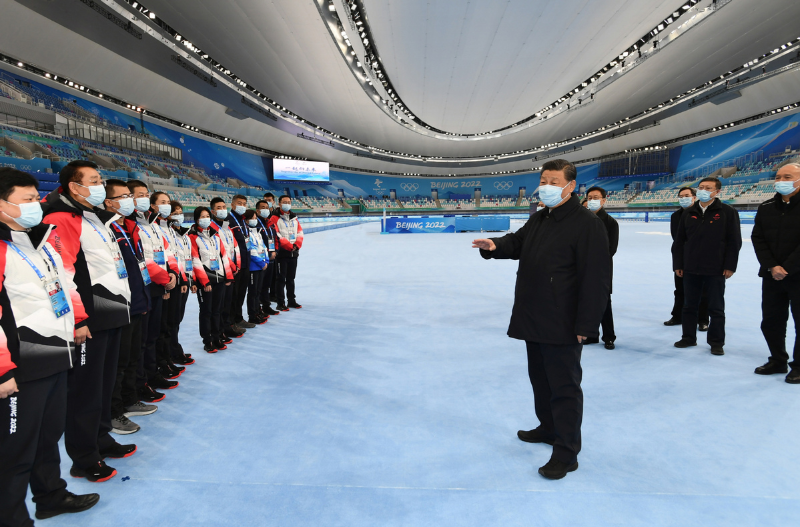

President Xi Jinping, also general secretary of the Communist Party of China Central Committee and chairman of the Central Military Commission, visits the National Speed Skating Oval in Beijing, on Jan 4, 2022. Xi inspected the preparations for the 2022 Olympic and Paralympic Winter Games in Beijing on Tuesday. [Photo/Xinhua]


BEIJING – Chinese President Xi Jinping has urged organizers to continue to work hard in the final stages of their preparations to ensure the complete success of the 2022 Olympic and Paralympic Winter Games.

Xi, also general secretary of the Communist Party of China Central Committee, made the remarks during his latest inspection of the Games’ preparatory work on Tuesday.

Xi said that a successful Beijing 2022 is China’s solemn commitment to the international community and after years of preparations, everything is ready.

“We are fully confident and capable of presenting to the world a fantastic, extraordinary and excellent Winter Olympics,” Xi noted.

At the National Speed Skating Oval, known locally as the “Ice Ribbon”, Xi inspected the interior decoration and track, and learned about the venue’s Games-time operation plan and event service preparations.

The National Speed Skating Oval is the only newly-built ice sports venue in the Beijing competition zone, and will stage speed skating competitions during the Winter Olympics.

Xi lauded the National Speed Skating Oval as a good example of low-carbon operation and multi-purpose utilization which has followed the “green, inclusive, open and clean” approach.

More Chinese elements should be integrated in the venue’s operation to make it an important window to showcase the unique features of Chinese culture and winter sports development, Xi said.

The “Ice Ribbon” is one of the first venues in the world to use carbon dioxide transcritical direct cooling ice technology for ice-making.

Xi noted that this technology should be promoted so as to contribute to the ecology-friendly transformation of China’s economy and society, as well as achieving low carbon dioxide emissions and carbon neutrality.

At the Main Media Center (MMC), Xi visited the main press conference room, media work room and intelligent dining hall to learn about the center’s construction and operation, COVID-19 countermeasures and whole-process service, Games-time information release, media operation and catering service.

In line with the concepts of hosting a green and frugal Games, the MMC features both the Main Press Center and International Broadcasting Center, and coordinates Games-time service and post-Games exhibition.

Noting that epidemic prevention and control is the biggest challenge for Beijing 2022 organizers, Xi said that access to watching the Games on site will be very limited due to the pandemic and extra importance should be attached to broadcasting and news reporting of the Games.

Xi thus called for efforts from the MMC venue operation team to ensure the smooth operation of news reporting, transmitting and broadcasting, with pandemic prevention and control measures such as the double closed-loop management in place.

Xi also hoped that domestic and overseas media outlets would better present stories about athletes fighting for Olympic glory, China’s endeavor in staging the Games and the Chinese people’s hospitality to showcase Beijing 2022 to the world in an all-round, dimensional and vivid manner.

Xi inspected the Athletes’ Village and heard reports on its construction, operation and COVID-19 countermeasures.

Xi noted that it is a good practice to convert the Village’s buildings into apartments after the closing of the Games, with its long-term use already taken into consideration.

He also hailed its courtyard-style design for demonstrating Beijing’s unique charm as a modern city with time-honored history.

During his visit to clinics and residence rooms for Paralympic athletes in the Village, Xi stressed the need to make facilities accessible and the importance of providing convenient, timely and meticulous services to the athletes.

At the Athletes Village, Xi also spoke to the operation and service team staff and volunteers, and praised their hard work.

The successful hosting of Beijing 2022 will not only enhance our confidence in realizing the rejuvenation of the Chinese nation, but also help present China as a positive, prosperous and open nation committed to building a community with a shared future for mankind, Xi said.

He added that working as volunteers for the Olympic and Paralympic Winter Games is a rare opportunity in one’s life, and called on the volunteers to work wholeheartedly and strengthen teamwork to ensure Games services go smoothly, and allow Games participants to feel the hospitality of Chinese people.

In the Games-time Operations Command Center, Xi stressed that a coordinated command system would be key to the success of Beijing 2022, and that the three competition zones should enhance coordination and centralized command.

Xi called on related sectors to fine-tune their work in the final month through test runs and close any loopholes.

Xi then visited Erqi Factory Training Base for Ice and Snow Sports, where a few Chinese national teams are gearing up for the Games.

Xi inspected high-tech training facilities such as wind tunnel laboratories and six-degree-of-freedom training halls, and saw equipment like the four-man bobsled, domestic wax truck and medical treatment stations.

Pushing forward the development of sports technologies is needed to build China into a sporting powerhouse, he said.

Xi watched a training session of China’s speed skating team and encouraged them to prepare in a scientific manner and strive for excellence.

He called on the athletes to fight bravely, fight smart and demonstrate Chinese athletes’ spirit and skills on the Olympic stage.

Xi also wished the athletes good luck at Beijing 2022, which was met with applause and chants of “we are ready!”

After visiting an exhibition about the development of winter sports in China, Xi said that China has achieved its goal of engaging 300 million people in winter sports.

He stressed that the ultimate goal of building a sporting powerhouse and a healthy China is to strengthen the people’s fitness, which also forms an essential part of China’s endeavor to build a modern socialist country in an all-round manner.

The enthusiasm brought about by Beijing 2022 should be maintained to promote sustainable development of winter sports at both elite and grassroots levels, Xi added.

https://www.wuhu.gov.cn/English/News/33571511.html
Guideline Seeks Better Lives for Elderly

By reconfiguring approach to aging, the problem can be turned into a bonus, experts say

China is taking measures to cope with an aging population by setting up new domestic nursing services, regulating the operation of nursing homes, protecting the rights of the elderly and expanding their access to education to bolster security and happiness.

In November, the Central Committee of the Communist Party of China and the State Council, China’s Cabinet, released a guideline on improving health services in which the elderly were encouraged to play an active role in society through continued education and greater access to entertainment.

The guideline stressed the need to enhance the protection of personal rights and create a more friendly environment for the elderly by improving public awareness of the importance of respect.

For example, all levels of government are required to set up service inventories or management systems to offer tailored services for seniors by evaluating their health and financial conditions. Domestic nursing services, rehabilitation care and social relief are further mandated.

Du Peng, vice-president of Renmin University of China said in a recent interview with Xinhua News Agency that creating such service inventories will help the government define which seniors require services, create standards to ensure they have access and also determine how they should apply for them.

He added that the establishment of a management system is important in giving governments active responsibility both for caring for the elderly and for devising tailor-made policies and support measures for companies wishing to play a role in the sector.

Improving the health of the elderly was also highlighted. Local governments should make more family doctors available to seniors with disabilities, severe diseases, or who are on low incomes. More State-level old-age centers and nursing clinics will be built to facilitate.

According to the seventh national census published in May, there are 264 million people aged 60 and above, accounting for 18.7 percent of the population. The size of China’s aging population has increased 5.44 percentage points since the previous national census in 2010.

To allow for a growing aging population, the guideline emphasized that policymaking bodies should take a positive attitude toward the group and respond to the problem promptly, scientifically and comprehensively by improving family-planning, employment and pension insurance mechanisms.

“We should not only recognize the problems and challenges of an aging population, but work to unleash potential by making the elderly active in society again. It’s a dialectical problem,” Wang Jianjun, an official from the National Health Commission, said at a news conference last month.

Pang Shi, director of the Department of Employment and Entrepreneurship at the Chinese Academy of Personal Science, said that developing the human resources of the aging population could effectively relieve the national labor shortfall.

“Though the structure of the population has changed as we are in an aged society, the elderly can still produce a demographic bonus. The previously existing standard for measuring such a bonus may have to be rectified,” Pang said.

“We have 260 million people aged 60 or above so far, with around 56 percent between 60 and 69, the younger end of the group. Among these ‘younger elderly’, most have the knowledge, the experience and the skills, as well as the good health to potentially rejoin the labor market,” she added.

“Seniors who work are better-off psychologically than those who are retired. Also, encouraging them to find jobs can help ease financial problems, further reducing or eliminating poverty among the elderly and boosting consumption,” Pang said.

She added that the public has a stereotypical view of the elderly, believing that they are unable to work or have more problems and said that it’s time to create a more positive view as the elderly can also contribute to society.

“As for policy, the government should combine pension policy with policies on employment, income and housing. Coping with the aging population on a systematic level will help improve the national pension system, and transform an aging problem into a new opportunity.”

The guideline also highlighted the development of sectors specifically catering to the elderly, such as food, medical services and smart devices, and encouraged companies and research centers to develop more tailor-made products through the use of cutting-edge technologies, for example, rehabilitation equipment to improve the quality of life.

Commercial insurance institutes have also been encouraged to create more commercially sustainable and economically sound health insurance policies for the elderly.

The government will take strict measures to crack down on illegal behavior that encroaches on the rights of the elderly-for example, the sale of counterfeit items-to create a safer, more trustworthy environment.

The aging problem is a key concern for the central government. China has made long-term plans for its aging population since 1994, and has enacted five State-level long-term plans focused on the group in the past 27 years.

https://www.wuhu.gov.cn/English/News/33571211.html

Higher-quality Employment Emphasized


As graduation nears, university students look at company profiles and available positions at a job fair in Nanjing, Jiangsu province, on May 16, 2021. YANG SUPING/FOR CHINA DAILY


    The Ministry of Education said on Tuesday it will make the utmost efforts to ensure college graduates find fuller and higher-quality employment amid a record number of students graduating from university next year.

    China is expected to have 10.76 million new college graduates next year, up by 1.67 million from this year, with the total number of graduates and the growth volume both setting records, said Wang Hui, director of the ministry’s department of college student affairs.

    The country’s economy is resilient and the economic fundamentals remain strong in the long term, which has laid a solid foundation for ensuring stable employment for college graduates, Wang said at a news conference.

    However, the employment situation remains complex as the country’s economic development still faces international and domestic challenges.

    Some graduates find it difficult to find jobs while some companies also have trouble hiring new employees, Wang said, adding that employment demand and supply varies greatly among students according to majors, industries and regions.

    The ministry will work with other government departments to ensure local authorities and universities effectively implement various employment promotion policies, Wang said.

The employment situation of the 9.09 million college graduates this year remained stable thanks to the concerted efforts of central and local governments, universities and enterprises, he said.

    Great support has been given to encourage graduates to work at grassroots levels and enlist in the military, while the hiring process for government institutions and State-owned enterprises has been moved forward a month, Wang said.

    Local governments and universities have made specific plans to help graduates from low-income families find jobs, and as a result, they have had a higher employment rate than other students, he added.

    Qiu Kenan, an official at the Guangdong provincial Department of Education, said SOEs in the province had hired 34,600 college graduates by the end of November and all private companies in the province had been encouraged to hire at least one college graduate.

    The province has also provided almost 600 million yuan ($94.2 million) in subsidies this year to more than 170,000 college graduates choosing to work at the grassroots level, and more than 150 million yuan in subsidies to more than 50,000 graduates from families with financial difficulties, he said.

    Yang Yixing, deputy director of the human resources department of China Electronics Corp, said the company hired 4,850 college graduates this year, up by almost 50 percent from last year.

    The company has hired more than 400 graduates from rural areas in Guizhou, Hainan, Shaanxi and Sichuan provinces, and it will continue to hire more graduates from rural areas and families with financial difficulties, he said.

    As the internet and communication industry is developing rapidly, the company will try to provide more and higher-quality job posts to new graduates, Yang said.

    It has signed cooperation agreements with 26 universities and incorporated the company’s professional skills into the training of the students so they can better meet the needs of the industry, he added.

https://www.wuhu.gov.cn/English/News/33213921.html

Chery’s Sales of Nearly 850,000 Vehicles in the First 11 Months Hit a Record High

Reporters recently learned from Chery Holding Group that, despite the “chip shortage”, Chery Group still achieved 110,281 car sales in November , a month-on-month growth of 24.8 percent and a year-on-year growth of 8.2 percent. From January to November, Chery Group sold 849,912 cars, increasing by 38.3 percent year on year and hitting a record high in the same period.

The major passenger car brands of Chery Group’s all saw rapid growth in November. Among them, Chery’s high-end brand Exeed sold 5,189 units (including exports), reaching a year–on–year rise of 135.4 percent. A new product of the brand “Chery Tiger 8 Plus” was newly launched, driving the sales volume of Chery (including export) in this month to 76,560 units, increasing by 18.6 percent year on year. A mid-size SUV of the brand Chery Jetour received more than 1,200 orders on 11th November.

In November, the monthly export of Chery Group exceeded 20,000 units for the seventh time in the year. The cumulative export from January to November was 237,901 units, a year–on–year growth of 137.6 percent, and the annual export is expected to exceed 250,000 units. Chery Group’s sales of new energy products doubled in November, with 88,911 units sold from January to November and an year-on-year increase of  145.2 percent.

Translated by Yuan Mengwen from Foreign Affairs Office of Wuhu Municipal People’s Government 

https://www.wuhu.gov.cn/English/News/33214611.html

Wuhu Rail Transit Line 2 Opened for Trial Service

The first phase of Wuhu Rail Transit Line 2 is about to open and operate, which will be open to public for a three-day trial ride from December 23 to 25. At that time, citizens can scan the code through the Wuhu Rail APP to enter the station for a free trial ride.

It is reported that the trial ride this time includes 11 stations of the first phase of the Rail Transit Line 2, and the trial time is from 9 am to 7 pm since December 23 to 25. Citizens need to download the Wuhu Rail APP in advance, complete the real-name authentication and bind the bank card, then they can scan the code to take the rail transit, reducing waiting time. Before entering the station, passengers are required to display the green health code, including those of the National Integrated Government Service Platform and of other provinces and cities. If the elderly, children and people with visual and hearing disabilities travel alone, they can be checked for their health code by station staff, or they can enter the station by providing paper health green code and negative nucleic acid test proof within 7 days.

 The first phase of Rail Transit Line 2 is about 16 km long with 10 elevated stations and an underground station. It is laid along the city from  east and west and 11 stations were set up, which are Wanchunhu Road Station, Mengxi Road Station, Huizhou Road Station, Haiyan Road Station, Zhengwuzhongxin Station, Yuncong Road station, Shenshan Park Station, Wuhu Railway Station, Shenshankou Station, Wenhua Road Station and Jiuzi Square Station.

Translated by Yuan Mengwen from Foreign Affairs Office of Wuhu Municipal People’s Government 

https://www.wuhu.gov.cn/English/News/33214771.html

Wuhu Actively Promotes the Virtuous Circle and Sound Development of the Real Estate Market

On December 17, it is learned from the press conference held by the Municipal Housing and Urban-Rural Development Bureau that Wuhu has always adhered to the principle that houses are for living in, not for speculation. The city has implemented a combination of measures to establish a mechanism for adjusting the prices of land and housing, keeping the overall stable operation of the real estate market.

According to statistics, from January to November, Wuhu has witnessed an increasing investment in the development of real estate market year-on-year. The city has completed an investment of 52.327 billion yuan in the market, a year-on-year increase of 16.9%, ranking third in the province in terms of its growth rate. Housing prices remained stable overall. In November, the average price of commercial housing in the city was 9,940.63 yuan per square meter, a year-on-year increase of 4.03%. The sales area of commercial housing was 6,656,400 square meters, a year-on-year increase of 37%, ranking first in the province concerning its growth rate. The listing of commercial housing has been accelerated as well, and the pre-sale area of commercial housing approved by the municipal government was 5,228,100 square meters, up 29.25% year-on-year.

Since the beginning of this year, Wuhu has continuously optimized the land supply structure, and selected different transfer measures in the auction of the use right of state-owned land, effectively preventing high land price from causing high housing price and disrupting market expectations. In the pricing of commercial housing, we strictly implement the filing of commercial housing prices, and guide real estate developers to make scientific and reasonable pricing through stringent housing price filing management. Meanwhile, we implement the notarization and lottery sales system of newly-built commercial housing and improve the pre-sale system. We continue to strengthen policy interpretation and market information disclosure, and improve the online media consultation mechanism. While guiding the positive public opinion, we strictly crack down on all kinds of chaos in the real estate market, strengthen the supervision system of risky real estate funds, effectively remove disputes and risks of overdue delivery of real estate projects, and resolutely safeguard the interests of the people and social stability.

Translated by Wang Mengxiao from Foreign Affairs Office of Wuhu Municipal People’s Government

https://www.wuhu.gov.cn/English/News/33214321.html

Municipal Party Secretary Shan Xiangqian Led A Delegation to Beijing for Investment Promotion

On December 17, Shan Xiangqian, secretary of the Municipal Party Committee, went to China Postal Express & Logistics Co., Ltd. and Beijing R&D Headquarters of LI Auto Inc. for investment promotion. Municipal officials Zhang Dong and Yao Kai attended.

China Postal Express & Logistics is mainly engaged in domestic and international express and contract logistics. By the end of 2020, the company had a registered capital of RMB 25 billion and nearly 160,000 employees. Shan Xiangqian introduced Wuhu’s accelerating the construction of Air Cargo Transportation Hub, National Port-based Logistics Hub and Express Demonstration City to the company. He said that in recent years, Wuhu has seized the historical opportunity of higher-quality integrated development in the Yangtze River Delta, given full play to the advantages of the golden waterway of the Yangtze River, actively built a regional logistics center integrating water, land and air in the Yangtze River Delta, so as to smooth the artery of regional economic integration with an intelligent and efficient modern logistics system. This year, Wuhu has deeply implemented the No.1 Project of “Investment Attraction and Talents Recruitment”, and taken multiple measures to create a relatively “preferential”, absolutely convenient, safety-oriented and equal business environment. We welcome enterprises like China Postal Express & Logistics to Wuhu for investment and cooperation, and the municipal party committee and municipal government will do their best to provide active, thoughtful and considerate services.

Ma Xiaoqun, general manager of China Postal Express & Logistics, said that Wuhu has a strong development momentum and we have laid a solid foundation for bilateral cooperation at the macro level. Next, we should focus on finding common ground of the industry, and promote substantial progress in bilateral cooperation through careful planning and in-depth connection.

Founded in 2015, LI Auto Inc. specializes in designing, developing, manufacturing and selling high-end intelligent electric vehicles, acting as a new representative of electric vehicles in China. Shan Xiangqian came to the company’s R&D headquarters in Beijing to learn more about the company’s development path, technological advantages, future plans, etc., and chose a car of LI for a test drive. He expressed the hope that on the basis of the consensus reached earlier, the two sides would speed up the setting of phased goals, specify details of cooperation, and promote LI’s participation in the development of automobile industry in Wuhu. We will provide all-factor guarantee to support LI to grow bigger and stronger in Wuhu, according to him.

The senior executives of LI highly praised Wuhu’s open-mindedness, pragmatic and efficient working style, and they were full of confidence in the future cooperation between the two sides and put forward some relevant suggestions.

Translated by Wang Mengxiao from Foreign Affairs Office of Wuhu Municipal People’s Government

https://www.wuhu.gov.cn/English/News/33214131.html

Economic Stability to Be Focus in 2022

Policy fine-tuning likely in energy sector to maintain production, growth

Economic stability will be the top priority of China’s policymakers next year, as they are expected to roll out supportive measures ahead of schedule to shore up growth against strong headwinds and will likely set 5 percent as the bottom line for GDP growth for 2022, experts said on Sunday.

Policymakers will intensify fiscal spending to boost domestic demand and increase infrastructure investment and are likely to fine-tune regulatory measures in the energy sector to stabilize production and growth, they said.

China’s top leadership acknowledged that the country is facing threefold pressure from contraction of demand, supply shocks and weaker expectations, and it pledged to safeguard economic stability amid rising domestic and external challenges at the tone-setting annual Central Economic Work Conference, which concluded on Friday.

Top policymakers at the meeting decided that supportive policies should be implemented ahead of schedule, and all regions and departments should actively roll out policies conducive to economic stability, according to a statement released after the meeting.

Experts said that the emphasis on economic stability signals that China will pursue a more pro-growth policy to avoid deep economic slowdown, as the world’s second-largest economy is likely to face strong downward pressure in the first half of next year before rebounding in the second half.

Most economists agreed that setting a reasonable growth target for next year is important for the government to better anchor the weakened market expectations. Policy support needs to be further intensified, because the Chinese economy may continue to be threatened by weaker growth of consumption and investment, disruptions of the supply chain, resurgence of the COVID-19 pandemic and the negative spillover effect of developed economies exiting their ultra-loose policies, they said.

Zhang Lianqi, a member of the Standing Committee of the 13th National Committee of the Chinese People’s Political Consultative Conference, China’s top political advisory body, said China may set next year’s GDP growth target at around 5.5 percent year-on-year, with 5 percent growth expected to be the bottom line.

“Stability will be the top focus of economic policies in 2022,” Zhang said.

The key economic meeting also stressed the importance of strengthening policy coordination, sticking with a systemic approach and improving policy effectiveness, which were seen as signs that policymakers will work to avoid any negative effect of its regulatory policies that could weigh on economic growth, experts said.

Han Wenxiu, a senior official with the Central Committee for Financial and Economic Affairs, said on Saturday that the government should be cautious about unveiling policies that could trigger economic contraction. The government should also avoid launching policies that are reasonable separately but could have negative effects as a whole, he added.

Wu Chaoming, chief economist at Chasing Securities, said that the country is expected to fine-tune regulations in areas such as the property market and capital expansion in certain sectors to foster well-regulated and healthy development, instead of launching stern regulatory moves that could trigger contractions of economic activities.

It is necessary to prevent industrial regulations from diluting macro policy support and aggravating economic downside risks, Wu said.

Looking forward, a more proactive fiscal policy can be expected as the government will launch additional tax and fee cuts to alleviate financial burdens on smaller enterprises and ensure stable employment. Public spending and the issuance of local government bonds will also be accelerated to boost infrastructure investment, said Wen Bin, chief researcher at China Minsheng Bank.

China’s monetary policy will maintain a flexible stance to ensure ample liquidity, and additional reduction of banks’ reserve requirement ratio and interest rate cuts remain viable options of the Chinese central bank if the economy further decelerates in the first half of next year, Wen said.

https://www.wuhu.gov.cn/English/News/33207761.html

Policy Moves Expected to Sustain Growth

CPC leadership highlights ‘stability’ as priority for economic work next year

China can leverage more policies to maintain economic stability and prevent financial risks, amid the rise in coronavirus infections and global inflationary pressure, International Monetary Fund experts and former finance officials said.

The country’s economic performance has been better than the rest of the world’s, because it has more policy space to respond to the impact of the COVID-19 pandemic, including stronger fiscal and monetary measures, they said.

These policies will help China’s economy recover better than other countries, Steven Barnett, senior representative of the IMF in China, said during a virtual seminar on Wednesday.

In the World Economic Outlook report published in October, IMF experts said new challenges may emerge due to the faster-than-expected monetary tightening of the US Federal Reserve and underestimations of inflationary pressure.

Inflationary pressure is mainly driven by firmer demand, commodity price pressures and supply chain disruptions, IMF economists said at the seminar.

Christoffer Koch, an economist from the IMF’s research department, said central banks can generally get through transitory inflationary pressures and avoid tightening until there is more clarity on underlying price dynamics. However, they should be prepared to act quickly if the recovery is faster than expected or the risk of “rising inflation expectations becomes tangible”, he said.

The Political Bureau of the Communist Party of China Central Committee, the Party’s core leadership, held a meeting on Monday that highlighted “stability” as the priority for economic work next year.

The People’s Bank of China, the central bank, announced on Monday a 50 basis point cut in the reserve requirement ratio for almost all financial institutions, effective Dec 15, to inject 1.2 trillion yuan ($189 billion) liquidity into financial markets.

More policies are expected to be released after the Central Economic Work Conference, and economists have predicted further easing measures to prevent a hard landing of the economy.

“We may see another 50 basis point RRR cut in the first half of 2022, but still view the likelihood of a policy rate cut as quite small, due to elevated production-price inflation and still rising consumer-price inflation,” said Lu Ting, chief economist in China at Nomura Securities.

Wei Benhua, former deputy head of the State Administration of Foreign Exchange and former IMF executive director for China, said that China has adopted a monetary policy that is suitable for the nation’s conditions. A prudent monetary policy will better support the real economy without the need for aggressive easing.

The central bank has also established a risk-warning mechanism after learning lessons from the global financial crisis, Wei said. China has taken note of the risks of an early retreat from quantitative easing measures adopted by central banks in some developed countries.

Guan Tao, global chief economist at BOC International and a former official at the State Administration of Foreign Exchange, said disruption to global supply chains caused by the pandemic could mean sustained inflationary pressure.

“Central banks might have underestimated the inflationary risk,” Guan said, adding that the effects of aggressive monetary easing have been accumulating since the 2008 global financial crisis. If financial markets cannot absorb inflation, price rises in the real economy could lead to significant issues, he added.

IMF economist Koch said to avoid “taper tantrum” scenarios, which usually result in spillovers such as the shifting of capital flows and foreign exchange rate fluctuations, monetary authorities need to focus on forward guidance and communication. Policy normalization from advanced economies’ central banks must also be taken into consideration by the authorities, Koch said.

Kristalina Georgieva, IMF managing director, said at the conclusion of the Sixth “1+6″Roundtable on Monday that China had “achieved a truly remarkable recovery, but its growth momentum has been slowing notably”.

“As China is a vital engine for global growth, taking strong actions to support high-quality growth will help not only China, but the world,” she said.

https://www.wuhu.gov.cn/English/News/33207331.html

China Has 393 Million Vehicles, 479 Million Registered Drivers

A Chery employee installs parts in a vehicle at the company’s plant in Wuhu, Anhui province. [Photo/Xinhua]


China had 393 million motor vehicles and 479 million registered drivers by the end of November, respectively, 1.64 times and 1.85 times of the numbers 10 years ago, the Ministry of Public Security said on Thursday. 

Thursday was also the 10th National Traffic Safety Day. According to the Traffic Management Bureau of the ministry, nearly 700 traffic police and auxiliary traffic police died at their posts.

Although both the number of vehicles and drivers kept growing and the traffic pressure continued to rise, the death toll of road traffic accidents in every 10,000 vehicles showed an overall downward trend, it said. 

To better facilitate the public and benefit enterprises, starting from Dec 10, four traffic-related measures will be implemented nationwide, and they are: applying and getting the electronic driving license, registration of second-hand car transactions in different places, examining and issuing electronic traffic code for trucks via “Traffic management 12123” mobile applications and accessing traffic accident evidence materials online.

The electronic driving license has covered 200 cities by now, attracting widespread attention and popularity, and more than 50 million drivers have obtained electronic driving licenses, it said.

The business of examining and issuing electronic traffic codes for trucks online has covered 245 cities and drivers can apply directly online. About 60,000 such codes have been issued by traffic regulators, further empowering the freight transport industry and helping build a modern circulation system.

https://www.wuhu.gov.cn/English/News/33207101.html