Skip to contentSkip to left sidebar Skip to footer

Author: WuhuW

Profits of Wuhu Municipal State-owned Enterprises Up 19% Last Year

It is learned from the State-owned Assets Supervision and Administration Commission of Wuhu Municipal People’s Government that economic indicators of the municipal state-owned enterprises grew steadily in 2021. In the whole year, the total revenue of the municipal state-owned enterprises reached 53.967 billion yuan, up 46.83% year-on-year, and the total profits achieved 808 million yuan, up 18.95% year-on-year.

The state-owned capital has been greatly increased. By the end of last year, the total assets of the municipal state-owned enterprises reached 257.998 billion yuan, and the total net assets were 109.001 billion yuan, up 8.65% and 4.66% respectively year-on-year. Meanwhile, the reform of state-owned enterprises has been implemented in depth, and the construction of major projects has been accelerated. At present, 93.24% of the 74 tasks specified in the “Three-Year Action Plan for the Reform of State-owned Enterprises” have been completed. The city has also integrated 29 municipal state-owned enterprises into nine, reorganized the municipal Construction Investment Co., Ltd, established Wuhu State Owned Capital Investment & Operation Co., Ltd and the Zhongjiang Urban Construction Group, and created the main platform for state-owned capital investment and operation, state-owned assets management and urban infrastructure investment. In addition, Wuhu-Xuanzhou Airport was opened to traffic smoothly, Rail Transit Lines 1 and 2 were put into operation, and the construction of the Chengnan River Crossing Tunnel was started as well. All these major projects are making contributions to the high-quality development of Wuhu.

Translated by Wang Mengxiao from Foreign Affairs Office of Wuhu Municipal People’s Government

https://www.wuhu.gov.cn/English/News/33800701.html

Wuhu’s Economic Growth Ranks First in the Yangtze River Delta Region

A few days ago, 16 cities of Anhui released their economic reports in 2021. In terms of economic growth, 11 cities of the province “outperformed” the province’s economic growth of 8.3 percent, among which Wuhu, Lu’an, Chizhou and Xuancheng achieved double-digit growth. It is worth mentioning that Wuhu ranks first among 41 cities in the Yangtze River Delta region with the economic growth at 11.6 percent.

According to the data released by the press conference on the economic development of Wuhu in 2021, and the unified accounting results of the regional GDP, Wuhu’s GDP reached 430.263 billion yuan last year, an increase of 11.6 percent over the previous year, and its GDP growth ranked first in the province. In terms of industries, the added value of the primary industry was 16.958 billion yuan, an increase of 6.4 percent over the previous year, with the secondary industry reaching 204.896 billion yuan, an increase of 11.9 percent, and the tertiary industry reaching 208.409 billion yuan, an increase of 11.7 percent.

In 2021, with the help of the measures launched by Wuhu municipal government, namely, “Investment Attraction and Talents Recruitment” and “1% Work Law”, the city’s economic growth ranked first again in the province after six years, and other leading economic indicators grew faster than the average level of the whole province. For instance, the growth of the total output value of the construction industry ranked first in the province, with the total retail sales of social consumer goods ranking second, the per capita disposable income of residents and private investment ranking third, the output value of strategic emerging industries, and technological upgrading investment ranking fourth, and the added value of large-scale industries ranking fifth.

Translated by Wang Mengxiao from Foreign Affairs Office of Wuhu Municipal People’s Government

https://www.wuhu.gov.cn/English/News/33800761.html

A Greener, High-tech Opening Ceremony

Editor’s note: China has overcome many odds to host the 2022 Winter Olympics. Two experts and a China Daily writer analyze China’s achievements in sports, and propose measures it needs to take to further promote sports, especially winter sports, in the country.

The opening ceremony of an Olympic Games, be it the Summer or Winter Games, is normally an extraordinary, intricately choreographed extravaganza, which attracts hundreds of millions of viewers on television across the world. It is also a spectacle, a majestic show, through which the host nation showcases its culture, history, traditions, and socioeconomic achievements.

The message of the opening ceremony for the Beijing 2008 Summer Olympic Games was peace, which was conveyed through the flying apsaras, the moving types, the Chinese paper scroll, the ancient Chinese drums, the Olympic rings and the colorful fireworks.

But the opening ceremony of the Beijing 2022 Winter Olympic Games on the evening of Feb 4 was different, yet splendid. The audiences were treated to a pared down ceremony, without the large-scale artistic performances that marked the 2008 opening ceremony, but it was no less symbolic-symbolic of a shared future for humankind.

In a bid to hold a simple, safe and yet spectacular Winter Games, the opening ceremony on Friday was not lengthy or marked with a large-scale performance. Even the number of performers-about 15,000 in 2008-was down to 3,000, and the duration of the ceremony was reduced to about 100 minutes because of the cold weather and the COVID-19 pandemic. The Olympic cauldron at the snowflake-themed ceremony was small, but the flames conveyed significant messages of greener Olympic Games.

The use of advanced technologies such as artificial intelligence, machine vision, 5G and cloud broadcasting added to the novelty of the opening ceremony. The performances, carrying forward the theme of global peace and shared future for humankind, focused on environmental protection, and human health and physical fitness, highlighting the importance of sports in instilling new confidence in the international community to contain the pandemic.

Through Friday’s opening ceremony, people could clearly see China’s pursuit of building a peaceful world, its reflection of the new Olympic motto of “Faster, Higher, Stronger-Together” and the Beijing Winter Games’ motto of “Together for a Shared Future”.

By reducing the duration of the opening ceremony, China has adhered to the concept of “Green, Inclusive, Open and Clean” Beijing Winter Olympics. That the reduced duration also lowered the cost was an added bonus.

To reduce the carbon footprint of the Winter Games, all the Olympic venues are being run on clean energy-and after the Games, they will be open for the public all year round and will stage high-level winter sports events. Also, during the preparations for the Games, all the work was done in an environmentally friendly manner. For example, about 70 percent of the materials used in the Games have been obtained through lease, including new sporting equipment, furniture in the Olympic village, technical devices, even bed sheets and quilt covers.

In line with Beijing 2022’s concept of hosting a green Winter Olympic and Paralympic Games, the medal podiums are made of recyclable and environmentally friendly materials. Hand-knitted bouquets, rather than real flowers, will be presented to the winners. The cashmere bouquets, in fact, will not only look like the real bouquets even after years but also honor the concept of sustainability.

More important, thrift, a traditional Chinese virtue, can help build a healthy social environment for China to realize its targets of peaking carbon emissions before 2030 and carbon neutrality before 2060. All this make the 2022 Winter Games an important Olympics to focus on achieving carbon neutrality.

For China, holding a simple, safe and yet spectacular opening ceremony is not just a slogan, it’s a philosophy, a way of life in the true sense of term.

https://www.wuhu.gov.cn/English/News/33800241.html

More Than Just an Opening Ceremony at this Winter Olympics


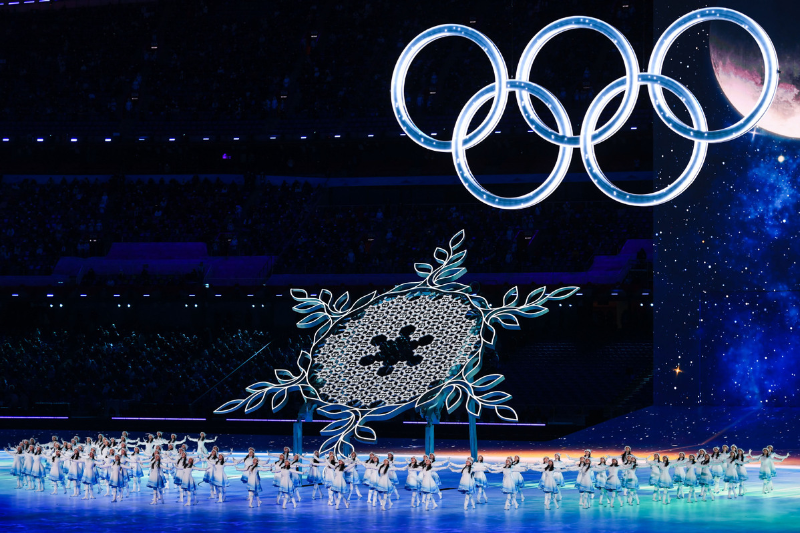
A ‘Forming a Snowflake’ show is presented during the opening ceremony of the Beijing 2022 Olympic Winter Games at the National Stadium in Beijing, Feb 4, 2022. [Photo/Xinhua]


On Feb 4, an eye-catching and much-awaited opening ceremony was held at the National Stadium, also called the Bird’s Nest, in Beijing to officially start the 2022 Winter Olympics. The ceremony attracted the world’s attention, saw the attendance of around 31 world leaders, including heads of states, governments and multi-national organizations, and made history as Beijing became the first city ever to host both a summer and winter Olympic Games.

While the stunning memories of the 2008 Olympic opening ceremony are still fresh, rather than duplicate the 2008 classics, this year’s opening ceremony was just as spectacular and memorable, only lighter, greener and more exquisite. Partly due to the Covid-19 pandemic, Friday’s event was noticeably toned down and shortened to about 100 minutes, with 3,000 people taking part instead of 15,000, compared to the 2008 spectacle. “Being splendid is not necessarily reflected in quantity,” said Zhang Yimou, the chief director of the event. With the use of many cutting-edge technologies such as 5G, machine vision and AI, the ceremony served as a visual feast with fantastic lighting and images, demonstrating the true meaning of “quality over quantity” and technological development of the country.

The opening ceremony started with a countdown of the 24 solar terms, delighting the audience, as the first of the 24 solar terms of this Chinese lunar year “Beginning of Spring” fell on this very day. Spring represents hope and new life. Amid the pandemic and international political controversy, hope is the one thing that the whole world is in desperate need of, to regain trust and restart. Adversity can only be overcome through solidarity.

“Together for a Shared Future,” this Winter Olympics slogan, was incorporated and displayed throughout the entire ceremony. Passing the Chinese national flag was one of the most touching scenes. The five-star red flag was passed by hand by 100 Chinese people of all ages, from all walks of life, and all ethnic minorities, and eventually in the hands of the flag-raisers. Apart from national solidarity, international togetherness was also emphasized. The parade of athletes, instead of having music recorded specifically, was accompanied by a selection of 19 well-known classical music excerpts ranging from “Turkish March” to “Symphony No.5 in C Minor,” to show respect for the culture of the whole world. What’s more, the forming of a snowflake that was a feature of the show perfectly explained the Chinese philosophy of “harmony in diversity” and “strength in unity”. The banners that had been held up in front of teams of each nation as they made their entrance eventually interlocked with one another into one giant snowflake, symbolizing one united human nation, a shared community of mankind. It sends the message that however different we may appear, there’s far more that unites us than divides us.

Denoting the Olympic spirit of “Higher, faster, stronger and together,” the cauldron lighting has always been the most breathtaking part of the opening ceremony. This year, the Olympic cauldron was lit by a Uyghur cross-country skier Dinigeer Yilamujiang and Nordic Combined athlete Jiawen Zhao, to represent gender equality. And for the first time in Olympic history, the small yet powerful flame of the Olympic cauldron also conveyed the idea of a “greener” future and was a call for solidarity, as in, “A single spark can start a prairie fire.” Furthermore, this bold, innovative and revolutionary change was jointly decided by both China and IOC after much discussion, in the hopes of spreading “green” ideas and encouraging people, and for the Games to adhere to the concept of low-carbon and sustainability.

The successful opening ceremony has won the world’s acclaim. It wasn’t just a wonderful spectacle but also a message bearer. It made people wonder and ponder. The world today is undergoing profound transformations and facing multiple challenges under the combined impact of great changes and once-in-a-century pandemic. In this special period of time, besides merely games and competitions, more importantly, the Olympic Games can play a unique role in galvanizing global solidarity and cooperation, and its spirit serves as a beacon for people to get over this difficult time. In the wars against the pandemic, climate change and so forth, no country can be better off on its own. It’s time to set aside prejudices and politics to make room for trust and sound policy. The whole world needs to stick together to be stronger and forge ahead with courage and fortitude, because to build a safe, peaceful and sustainable home requires solutions and actions from not only “me” but also “us”. And China is proud to say, “The world is turning its eyes to China, and China is ready.”

https://www.wuhu.gov.cn/English/News/33800201.html

Wuhu Held A Meeting on Epidemic Prevention and Control

On January 17, Wuhu held a meeting on COVID-19 prevention and control. He Dong, Member of Standing Committee of CPC Wuhu Municipal Committee and Vice Mayor attended the meeting.

The meeting points out that as the Spring Festival approaches, increased movement makes it easier for people to gather together, which gives more pressure to preventing imported cases. All cities, counties, towns and villages should be on duty at all times, and the telephone lines for epidemic consultation and reporting should be kept open 24 hours a day so that people can answer questions, explain their doubts and report when they return home. To prevent imported cases is the top priority. Taking the community as a unit, comprehensive and active survey and registration of people from other provinces should be done timely in accordance with regulations. We need to properly control public places, key places, and rural areas and ensure the control of cold-chain food, international mails and goods. We need to carry out self-examination and self-correction in response to problems in other areas, and improve all the measures. Emergency preparedness should be made in advance, and epidemic prevention and control and Spring Festival travel should be coordinated to ensure that the people have a stable and peaceful Spring Festival.

At the meeting, a briefing on the supervision and inspection of the epidemic prevention and control in the whole city was heard, and the key work of epidemic prevention and control in the near future was arranged.

Translated by Yuan Mengwen from Foreign Affairs Office of Wuhu Municipal People’s Government 

https://www.wuhu.gov.cn/English/News/33611431.html

Wuhu Agricultural Products Promotion Center Operated

On January 15th, the opening ceremony of the exhibition center of Anhui Supply and Marketing Platform (Agricultural Products Promotion Center for Rural Revitalization in Wuhu) was held. Wu Liangsi, Party Secretary and Director of the Council of Anhui Provincial Supply and Marketing Cooperative, Zhu Yongdong, Party Member and Deputy Director of Anhui Provincial Rural Revitalization Bureau, Wang Bin, Party Member and Deputy Director of the Council of Anhui Provincial Supply and Marketing Cooperative, attended the opening ceremony, and Cai Yi, Vice Mayor of Wuhu, delivered a speech.

Cai Yi said in his speech that the opening of the center is a Wuhu action based on the new development stage and staying up to date with the times, a Wuhu practice that adheres to the common development of the municipal government and the society, and a Wuhu innovation that increases farmers’ income and realizes common prosperity. With the official operation of the exhibition center (promotion center), the platform for accelerating the circulation of agricultural products, helping farmers increase their income and promoting agricultural efficiency has been successfully set up. We sincerely welcome special agricultural products from various regions to settle in the center, and hope that the local authority, enterprises, institutions and citizens at all levels will fully support the development of the center and jointly help build a Wuhu model for comprehensive rural revitalization.

After the opening ceremony, the officials and guests attending the ceremony visited the exhibition center together.

Translated by Wang Mengxiao from Foreign Affairs Office of Wuhu Municipal People’s Government

https://www.wuhu.gov.cn/English/News/33571091.html

Wuhu Global Air Cargo Hub Project Promoted at a High Level

At this year’s provincial “Two Sessions”, Chen Yi, a member of the CPPCC Anhui Provincial Committee in Wuhu, suggested that Wuhu Global Air Cargo Hub Project (hereinafter referred to as “Wuhu Global Port”) should be promoted at a high level.

Wuhu Global Port Project has been included in the implementation plan of the integration of Yangtze River Delta in the 14th Five-Year Plan, the coordinated development plan of civil aviation in Yangtze River Delta and the provincial 14th Five-Year Plan, and it is required to formulate the construction plan of Wuhu Global Port during the 14th Five-Year Plan.

According to the strategic cooperation agreement signed by Anhui Provincial Government, Wuhu Municipal Government and Joybuy Group (JD.COM) and the project planning, the overall positioning of Wuhu Global Port is to build Wuhu–Xuanzhou Airport into a professional cargo hub, creating a global air cargo network and an internationally competitive air cargo hub.

Chen Yi suggested that we should speed up formulating special plans for the construction of the air cargo in Anhui Province at the provincial level, and determine the functional orientation and regional layout of the air cargo in the province, so as to accelerate the development of the air cargo industry and the integration into the Yangtze River Delta, the national and global air cargo market.

She also suggested setting up a group of officials responsible for Global Port Project led by Anhui provincial officials, together with the Provincial Development and Reform Commission, the Provincial Department of Transportation, the Provincial Department of Civil Affairs, the Provincial Department of Natural Resources, the Provincial Department of Commerce and the Provincial Department of Finance, etc., and transferring the specialized personnel from relevant departments at the provincial or municipal level to work together, and formulating a list of responsibilities, a timetable and a road map.

According to Chen Yi, it is necessary to support the revision and approval of general regulations and the reconstruction and expansion of Wuhu-Xuanzhou Airport, coordinate with Shanghai Railway Administration, support the reconstruction and expansion of Taqiao Railway Logistics Base and Sanyuan Cargo Terminal, and plan to introduce high-speed rail logistics into Wuhu-Xuanzhou Airport on a pilot basis; planning the construction of international air cargo stations, customs, inspection and quarantine and other infrastructure.

“We should increase the support on the policy, funds, and land use.” Chen Yi added. She also suggested assisting in the opening declaration of the airport and the planning of the bonded area at the airport and the expansion of China (Anhui) Pilot Free Trade Zone Wuhu Area. In addition, the provincial government should provide financial support concerning the special fund for civil aviation, the funds within the central budget and the provincial government funds.

Translated by Wang Mengxiao from Foreign Affairs Office of Wuhu Municipal People’s Government 

https://www.wuhu.gov.cn/English/News/33570981.html

Wuhu High-speed Railway Extends to Western Regions

Reporters learned that recently, Huanggang-Huangmei High-speed Railway has entered the completion acceptance stage and will soon enter the joint adjustment test, which marks another step closer to the opening of this high-speed railway line. After the opening of the Huanggang-Huangmei High-speed Railway, it only takes two hours from Wuhu to Wuhan, marking that another passenger transport channel opening to the western region.

Huanggang–Huangmei High-speed Railway, an extension of the Wugang Intercity Railway Line, starts from Huanggangdong Station in the north, via Huanggang urban area, Xishui County, Qichun County, Wuxue City, Huangmei County, and connecting Anhui-Jiujiang High-speed Railway that has opened operation at Huangmeidong Station.

Construction of this 125.12-kilometer line began in December 2018, with five stations and a designed speed of 350 kilometers per hour. It is an important part of Beijing-Hong Kong (Taiwan) Channel, one of the main channel of the “eight vertical and eight horizontal” high-speed railway network in China’s “Medium and Long Term Railway Network Planning”, and also a part of the high-speed railway from Wuhan to Hangzhou. This line is of great significance for improving the railway network layout of the Yangtze River Economic Belt, promoting the revitalization and development of the old revolutionary base areas of Dabie Mountains, and driving the coordinated development of Wuhan metropolitan area.

The reporter learned that Nanjing-Anqing High-speed Railway is connected with the Anhui-Jiujiang section of Beijing-Hong Kong High-speed Railway. At present, the Anhui-Jiujiang section of Beijing-Hong Kong High-speed Railway has been put into operation, while Huanggang-Huangmei High-speed Railway will soon be completed and open to traffic. After that, another fast and convenient passenger transport channel with large transport capacity from Wuhu to Wuhan will be added in the east-west direction. By then, departing from Wuhu to Wuhan by high-speed rail, it is accessible to reach Wuhan from Wuhu via Anqing, Huangmeidong, Huanggang as well as via Hefei and Lu ‘an.

Translated by Yuan Mengwen from Foreign Affairs Office of Wuhu Municipal People’s Government 

https://www.wuhu.gov.cn/English/News/33611381.html

Why China’s Economy Remains Global Recovery Engine in 2022


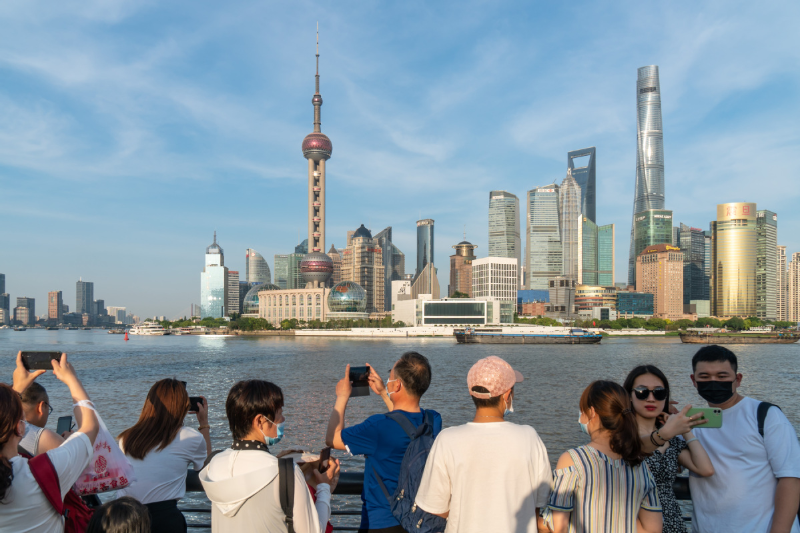
Tourists take photos at the Bund area of Shanghai. [Photo by Wang Gang/For China Daily]


BEIJING — China still raises hopes for a global recovery in 2022 with its strong economic resilience despite challenges and uncertainties amid the COVID-19 pandemic.

A report released at the International Finance Forum (IFF)’s annual meeting in December estimated that China would remain the largest contributor to global growth at 26.3 percent in 2021.

The International Monetary Fund forecasts that China’s economy will grow 5.6 percent this year, 0.7 percentage points higher than global economic growth.

Analysts believe that the world’s second-largest economy will be increasingly shaped by the power of consumption and innovation while continuing to seek greater synergy with global economies.

Consumption gains steam

In the first three quarters of 2021, final consumption expenditure contributed 64.8 percent to China’s economic growth, 3.1 percentage points higher than the level seen in the first half of the year, data from the National Bureau of Statistics showed.

Consumption acted as a pillar of China’s economy in 2021, and the country is expected to step up efforts in further unleashing consumer demand, said Wen Bin, chief analyst at China Minsheng Bank.

In 2022, the country will wield its microeconomic policies to stimulate the vitality of market entities and deepen the supply-side structural reform with a focus on smoothing the circulation of the national economy, said the tone-setting Central Economic Work Conference in December 2021.

China’s consumption market in solid expansion can underpin foreign trade growth, said Lin Wei, vice-chairman of the China Council for the Promotion of International Trade Zhejiang Provincial Committee.

The country’s massive market has contributed 14.8 percent to the global import growth in the first half of 2021, according to the Ministry of Commerce.

The implementation of the Regional Comprehensive Economic Partnership (RCEP) agreement on Jan 1 marked a new milestone for China’s opening-up. It means the country will fulfill commitments on service trade opening-up and investment negative lists.

News drivers emerging

This year, China will continue upgrading its industrial sector and seek new growth drivers, which will further catalyze the growth of foreign business in China.

China will take progressive moves in infrastructure investment and guide financial institutions to step up support for sci-tech innovation and green development.

High-tech manufacturing industries such as pharmaceuticals, computers, and office equipment are likely to maintain rapid growth amid the country’s continuous efforts to encourage sci-tech innovation in 2022, said Chen Weidong, a senior researcher with the Bank of China.

Tu Xinquan, a professor at the University of International Business and Economics, said that more foreign investment would flow into modern service industries and advanced manufacturing industries while China accelerates industrial restructuring.

The country’s transition to low-carbon development has also been luring investment into green technologies and creating opportunities for domestic and foreign companies.

At the fourth China International Import Expo in last November, automation giant Honeywell International signed cooperation agreements with more than 20 Chinese enterprises on green and low-carbon development, advanced manufacturing, and digitalization.

China’s green and low-carbon transformation has brought broad development opportunities to multinational enterprises, said Steven Lien, president of Honeywell China and Aerospace Asia Pacific.

https://www.wuhu.gov.cn/English/News/33571701.html

China to Accelerate Key Projects in 14th Five-Year Plan


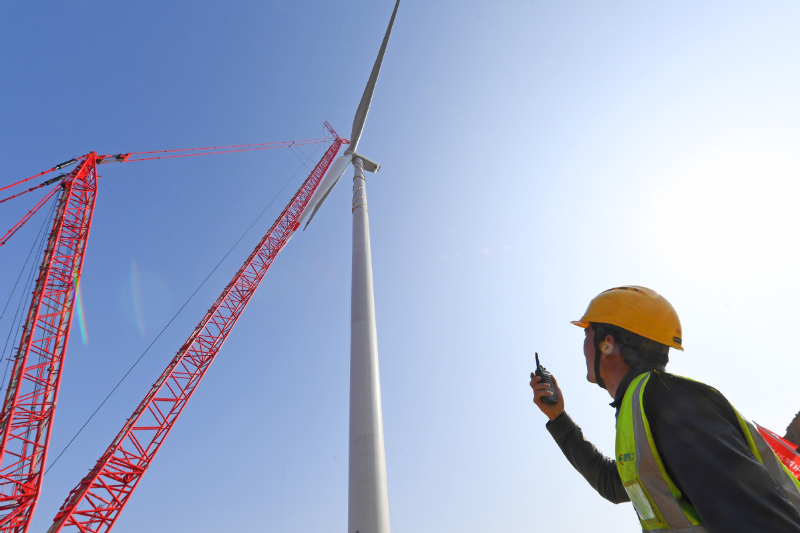
A technician oversees installation of a wind power turbine in Chuzhou, Anhui province. [Photo by Song Weixing / for China Daily]


BEIJING — China will accelerate the implementation of major projects outlined in the 14th Five-Year (2021-2025) plan for social and economic development with expanded investment, the State Council, or the cabinet, has decided.

A State Council executive meeting chaired by Premier Li Keqiang on Monday said that, as viable policies and detailed plans had been created, relevant authorities should speed up the major projects with solid measures and in an orderly fashion.

As the Chinese economy is in a crucial period, the country should give higher priority to stabilizing economic growth, continue its strategy of expanding domestic demand, and take targeted steps to boost consumption and investment, according to the meeting.

Pushing forward all major projects in the 14th Five-Year Plan period, the country will accordingly ensure the financing, land use and energy supply for critical sectors such as food and energy security, the advanced manufacturing and high-tech industries, logistics and telecommunications, and urban government-subsidized housing.

The meeting vowed streamlined administrative procedures for those ready-to-go projects, in particular major water-conservancy projects, to accelerate the implementation.

On the local level, the country will put into use the 1.2 trillion yuan ($188.5 billion) of local government special bonds issued in the fourth quarter of 2021, and accelerate the issuance of the front-loaded 2022 bond quota, the meeting decided.

The meeting also stressed accelerating the centralized bulk-buying of drugs, especially medicines for chronic diseases and common illnesses, and high-value medical consumables such as dental implants to further reduce medical costs.

By the end of last year, the government procurement had helped save 260 billion yuan in medical-insurance costs and patient expenditure, according to the meeting.

https://www.wuhu.gov.cn/English/News/33571651.html