Skip to contentSkip to left sidebar Skip to footer

News

Wuhu-Xuanzhou Airport is Expected to Open to Traffic By the End of This Month

A few days ago, the reporter learned from Wuhu-Xuanzhou Airport Construction Investment co.LTD that the airport project has completed the industry acceptance and permit review. Equipped with the sailing conditions,the airport is expected to be open to traffic by the end of this month.


According to the introduction, since the “13th Five Year Plan”, the airport company has made breakthroughs in various work, and completed the arduous task of “building up and flying up”. The carrying function of the airport has initially appeared, and the airport logistics industry is ready to emerge, which has created a new platform and added a new power source for the local economy to achieve high-quality development.


This year, the airport company put forward the annual work goal of “double improvement, double guarantee and double crossover“. “Double improvement” means to improve operation management ability and industrial investment attraction ability. “Double guarantee” means to ensure the operation of civil transport aircraft and general aviation aircraft. “Double crossover refers to the transform from general airport to specialized cargo airport and from regional airport to trunk airport. The airport company said that it would defend the lifeline of safe operation, guarantee the normal operation of flights, improve the planning and layout, promote the preliminary work of airport reconstruction and expansion and the construction of supporting projects, speed up the landing of airport industrial projects, and create a new platform for Wuhu’s high-quality development.

Translated by Yuan Mengwen from Foreign Affairs Office of Wuhu Municipal People’s Government

http://www.wuhu.gov.cn/English/News/30312891.html

50 Years on, Ping-Pong Diplomacy Shows Lasting Value

    – 50 years ago, a chance encounter between paddlers from China and the U.S. previewed the “Ping-Pong Diplomacy” that led to the normalization of bilateral ties.

    – Withstanding the changes in China-US relations for half a century, “Ping-Pong Diplomacy” still has profound implications in an ever-changing world.


    By Xinhua writers Su Bin, Yang Kai and Xu Dongyuan


    It has been half a century since China invited the U.S. table tennis team for a historic visit, and “Ping-Pong Diplomacy” still has profound implications in an ever-changing world.


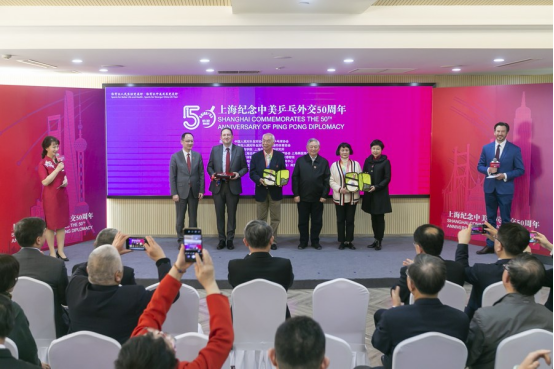
    On Saturday, a special event was staged in Shanghai in commemoration of the 50th anniversary of “Ping-Pong Diplomacy.”


    ”The Ping-Pong Diplomacy of 50 years ago is of special significance in the history of China-U.S. relations,” Chinese Ambassador to the United States Cui Tiankai said in a video speech to the event.


    ”The little ball moves the big ball” is a phrase that Chinese people often use when referring to that historical period, where table tennis became an unlikely diplomatic tool. 50 years later, the little ball is still moving in developing ties between different countries.


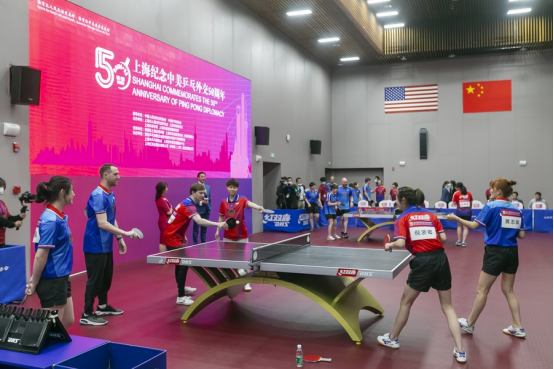
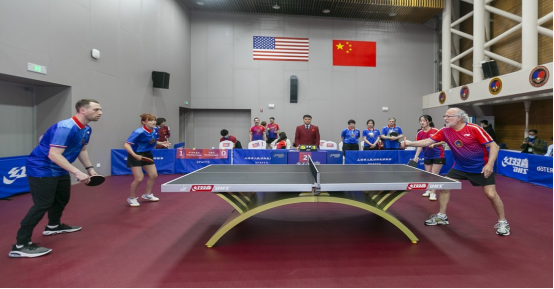
    Players from China and the United States take part in a friendly match to commemorate the 50th anniversary of the Ping-Pong Diplomacy at the International Table Tennis Federation Museum in Shanghai, east China, April 10, 2021. (Xinhua/Wang Xiang)


    A CHANCE ENCOUNTER MADE HISTORY


    The story of a chance encounter between deceased world champion Zhuang Zedong and American paddler Glenn Cowan on April 4, 1971 has been heard and repeated by many.


    After finishing his training session during the 31st World Championships in Nagoya, Japan, Cowan found himself aboard a bus with the Chinese team members on his way to the venue, a complicated scene in a period featuring a Cold War gulf between the two countries.


    Despite other members’ worried response, Zhuang stood up and reached out to Cowan. The world champion communicated with Cowan and gave him a piece of tapestry satin as a gift.


    A handshake between the two off the bus was captured by journalists on site, and related pictures soon hit the headlines on local newspapers.


    ”He (Zhuang) did a meaningful thing in the right way at the right time,” commented the ITTF honorary president Xu Yinsheng, who coached the Chinese team then.


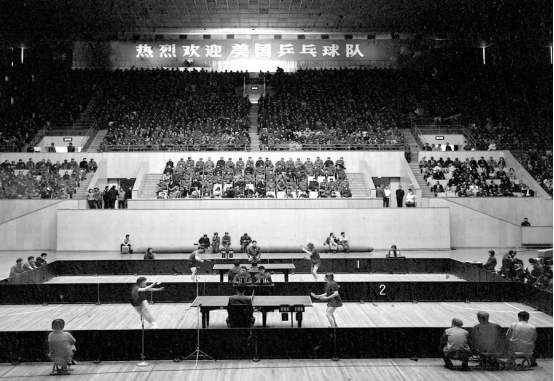
    Players of China and the United States take part in a table tennis friendly match in Beijing, China, April 13, 1971. (Xinhua)


    At the invitation of the Chinese delegation, a flight with the U.S. table tennis team on board landed at the Beijing airport on April 10, 1971. They became the first U.S. group to visit since the founding of the People’s Republic of China in 1949. The U.S. team played exhibition games with Chinese counterparts in Beijing and Shanghai.


    Sun Qilin, a former world championships chief umpire and professor from Shanghai Jiao Tong University, had a vivid impression after watching the exhibition game in Jiangwan Gymnasium in Shanghai’s Yangpu District.


    ”The air in that game was alive. ‘Ping-Pong Diplomacy’ motivated all Chinese people, and made huge contributions to bringing China and the U.S. closer. Through table tennis, a gate for friendly exchanges was opened,” said 71-year-old Sun, who led the Chinese team to several World University Games and Championships as either a coach or a team manager.


    The Chinese team paid a return visit the next year. The mutual visits broke the ice in two decades of estranged Sino-U.S. relations and eventually led to the normalization of bilateral ties.


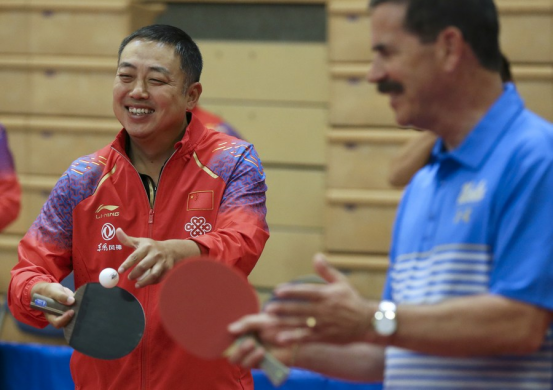
Liu Guoliang (L), president of the Chinese Table Tennis Association, serves the ball during a joint training session between the Chinese and U.S. national table tennis teams in Orange County, California, the United States, Aug. 17, 2019. (Xinhua/Li Ying)


    UNCHANGED IN A CHANGING WORLD


    ”Chinese table tennis is shared with the world,” said the sport’s legend Liu Guoliang after being appointed the Council Chair of World Table Tennis (WTT) in 2020.


    China is a dominant force in table tennis, claiming 28 out of 32 gold medals since the sport was introduced to the Olympic Games in 1988.


    The table tennis link between China and the U.S. is not only about commemoration activities, but also technique exchanges on the court.


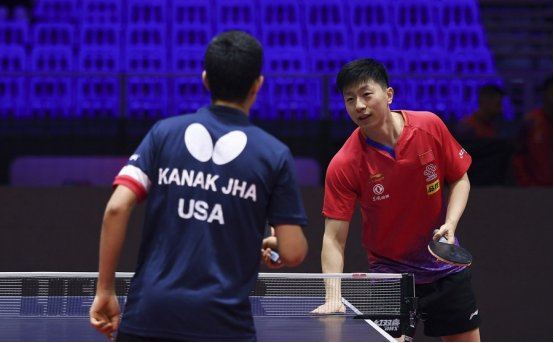
    During the 2019 World Championships in Budapest, four Chinese players, including Grand Slam winners Ma Long and Ding Ning, conducted a joint practice with their American counterparts in the venue.


Ma Long (R) of China and Kanak Jha of the United States communicate with each other during a joint practice session at the 2019 ITTF World Table Tennis Championships in Budapest, capital of Hungary, April 19, 2019. (Xinhua/Tao Xiyi)


    Now, “Ping-Pong Diplomacy” is present in a wider range. Not just complacent with its dominance in world table tennis, China has been engaging in deeper cooperation with other countries and regions, trying its best to make the sport more globally popular.


    A training center of China Table Tennis College in Papua New Guinea (PNG) was set up in November, 2018, when world champion Shi Zhihao and Grand Slam winner Zhang Yining gave instructions to local players in their training. After receiving training in the China Table Tennis College, the PNG table tennis team won two silver medals in the Pacific Games next July, the best result in its history.


    ”What has given me much pride as a table tennis professional is more than just the good results athletically that we have achieved, but also that table tennis has made great contributions to Chinese diplomacy and people-to-people exchanges with other countries and regions,” said Shi, current ITTF vice president.


Table tennis world champion Zhang Yining (L, front) from China gives instructions to a player from Papua New Guinea’s national team in Port Moresby, Papua New Guinea, Nov. 14, 2018. (Xinhua/Fei Maohua)


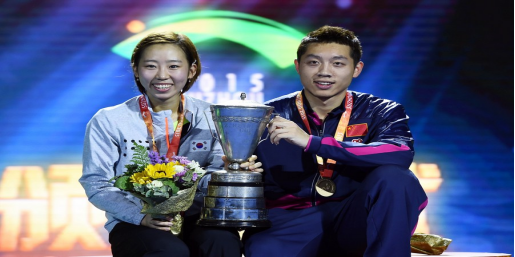
    Xu Xin paired with Yang Hae-un of South Korea to win the World Championships mixed doubles title in 2015.


    Outside the court, Chinese sports equipment giant Double Happiness (DHS) has been a gear supplier of six Olympic Games and 18 World Championships. The world’s leading producer in table tennis gear has also been serving the country’s “Ping-Pong Diplomacy” since its foundation 62 years ago.


    ”I’m proud of what we have done related to the ‘Ping-Pong Diplomacy’,” said Lou Shihe, general manager of the DHS.


China’s Xu Xin (R) shares the trophy with South Korea’s Yang Haeun on the podium during the awarding ceremony for the mixed doubles final match at the 53rd Table Tennis World Championships in Suzhou of east China’s Jiangsu Province, May 1, 2015. (Xinhua/Li Xiang)


    PING-PONG DIPLOMACY MARCHES ON


    The world nowadays is different from half a century ago, and especially the COVID-19 pandemic shows the necessity of consultation and cooperation among different countries and regions so as to effectively address global challenges, and sports should have a role to play.


    ”Today, the China-U.S. relationship faces a critical choice as to its future path. The two sides should inherit and carry forward the spirit of ‘Ping-Pong Diplomacy’ featuring mutual respect and seeking common ground while reserving differences,” Cui noted.


    ”At present, the pandemic and the great changes unseen in a century are intertwined, and traditional and non-traditional security threats have emerged one after another. In the face of varied global challenges, China and the United States can and should cooperate in more rather than fewer areas, and the fundamental force that moves the big ball is not weakened, but grows stronger.”


    ”Friendship from generation to generation is a common desire for both Chinese and American people,” said table tennis legend Zhang Xielin.


As another witness of the “Ping-Pong Diplomacy,” Zhang expects that through this commemorative event, people can remember the history and continue with people-to-people exchanges and friendship.


    In a video speech, former president of USA Table Tennis Sheri Cioroslan shared her story of learning about the “Ping-Pong Diplomacy” in a young age and efforts in carrying on the legacy of the “Ping-Pong Diplomacy” during her stint.


    ”There are so many memories to cherish and so many more to make,” she noted.


    Zhou Qingjie, director of Sports Exchange Research Center of China Foreign Affairs University, said sports exchanges have grown to an important tool in building international relations and a community with a shared future for mankind, as relevant parties have attached greater importance to people-to-people exchanges.


    ”The pandemic has raged the world since early 2020, and the international community has been in a complicated scenario. Different countries and their people call for more mutual exchanges than ever to realize peace and development and win-win cooperation, and sports has a unique role in fulfilling these visions,” he said.


Players from China and the United States take part in a friendly match to commemorate the 50th anniversary of the Ping-Pong Diplomacy at the International Table Tennis Federation Museum in Shanghai, east China, April 10, 2021. (Xinhua/Wang Xiang)


    A match followed the opening ceremony on Saturday, featuring four teams mixing Chinese and American table tennis lovers.


    Jeffrey Lehman, vice chancellor of New York University Shanghai, participated in the match. He recalled the scene of watching an exhibition game in 1972 as a high school student.


    ”Obviously (it was) a turning point. It was a critical moment that the story of these two players changed the history,” Lehman said.


    ”As for sports exchanges in the post-pandemic era, we need to blaze new trails in their form and open up more channels to embrace the world with an open mindset,” Zhou commented.


    ”Today’s world is totally different from that in 1971. ‘Ping-Pong Diplomacy’ cannot be replicated, but its implications deserve to be cherished,” said Lyu Xiang, a Sino-U.S. relations expert of the Chinese Academy of Social Sciences.

http://www.wuhu.gov.cn/English/News/30286951.html

EFORT Works Together with Alibaba Cloud to Build the Industry’s First Cloud Platform

    On March 31st, it is learned that with the help of Wuhu Municipal Development and Reform Commission and other relevant departments, EFORT Intelligent Equipment Co., Ltd., the domestic robot company, signed a framework cooperation agreement with Alibaba Cloud Computing Co. Ltd. The two sides will work together to build the industrys first intelligent robot cloud platform integrating cloud computing, edge computing and the terminal, so that robots can be available to more factories, taking the first step towards intelligence.


    China is the largest market for industrial robots. According to the latest report published by the International Federation of Robotics (IFR), there are 141,000 new industrial robots installed in China every year, but a large number of them are only used in automobile and electronic manufacturing sectors. A series of problems, such as complex programming, poor consistency of supplied materials, and frequent change of production, have hindered the mass application of traditional industrial robots in general industrial enterprises. Nearly half of the industrial robots still stay at the handling level and unable to enter into the key processes of production and manufacturing.


    ”EFORT hopes to solve the problem of mixedline production in small batches in factories through cooperation with Alibaba Cloud to provide better intelligent solutions for small and medium-sized enterprises that cannot afford or use robots, promoting industrial transformation and upgrading of enterprises in Anhui and then in China.said Xu Lijin, chairman of EFORT Intelligent Equipment Co., Ltd.


    According to the agreement, the two parties will integrate domestic self-developed robotics, machine vision, cloud computing and artificial intelligence, making Alibaba Cloud Industrial Brain the technical support of the EFORT Intelligent Robot Cloud Platform. The Cloud Platform can make it easier for engineers to do programming and algorithm application. It can also improve the autonomy and intelligence level of robots, meet the “flexible requirements” of mixed-line production in small batches, and make up for the lack of process engineers in small and medium-sized factories to a certain extent.


    ”Anhui’s intelligent manufacturing industry is booming. Alibaba Cloud hopes to cooperate with more local enterprises like EFORT, give full play to its technological, platform-based and ecological advantages, and deeply involve in the digital transformation and upgrading in Anhui.” said Dai Hua, general manager of Anhui Strategic Development Department of Alibaba Group.

Translated by Wang Mengxiao from Foreign Affairs Office of Wuhu Municipal People’s Government

http://www.wuhu.gov.cn/English/News/30286541.html

Wuhu-Xuanzhou Airport Plans to Open Routes to Xi ‘an, Kunming and Other Cities

The reporter learned from Anhui Branch of China Eastern Airlines that Wuhu-Xuanzhou Airport, which is about to open to traffic, plans to  open the routes to Xi’an, Kunming, Changchun and etc.


Civil Aviation Administration of China will carry out a new summer flight schedule from March 28. Anhui Branch of China Eastern Airlines recently released the summer flight plan in Anhui in 2021, planing to open routes in 4 civil airports in Hefei,Huangshan, Anqing and Fuyang, navigable to 33 cities, a total of 37 routes after the seasons transition.


The reporter learned that WuhuXuanzhou Airport is a 4C civil transport airport jointly invested by Wuhu and Xuancheng. It is a key planning and construction project during the “13th Five-Year Plan” period of the country and the province, and has been included as an important part of the world-class airport group in the Yangtze River Delta.


It is reported that for the construction of the flying area, the main runway of the airport has been completed and six boarding bridges have been installed in place. The number of configuration is second only to Hefei Xinqiao Airport in the province.

Translated by Yuan Mengwen from Foreign Affairs Office of Wuhu Municipal People’s Government

http://www.wuhu.gov.cn/English/News/30095751.html

Strongest Sandstorm in Decade Affects Anhui

    From 5am Tuesday, northern cities in East China’s Anhui province started to be hit by a sand and dust storm said to be the worst one in a decade as a result of cold weather, according to the Department of Ecology and Environment of Anhui Province.

    The air quality index (AQI) in Bozhou, Huaibei and Suzhou cities soared as the concentration of PM10 per hour exceeded 1,000 microgrammes per cubic meters,  and Bengbu, Fuyang and Huainan cities were hit by moderate air pollution, as of 8am Tuesday.

    Weather experts announced the analysis of sand and dust weather this time: sands in the boundary between southern Mongolia and Midwest area in inner Mongol were raised by strong cyclone and moved towards back position with cold air at night on Sunday. The weather started to affect the Beijing-Tianjin-Hebei region and Yangtze River Delta region from early in the morning on Monday to Tuesday.

    According to the Ministry of Ecology and Environment, sands are moving to southern areas now, and under northerly air control, the weather will impact on all cities in Anhui from north to south. Major pollution dominates air quality from Tuesday to Thursday, and the situation might be worsen in northern Huai River, Yangze River and Huai River region. There will be major pollution in the south of the Yangtze River. Quality of air will recover affected by easterly wind and rainfall after Thursday.

    The department has suggested the public not go to outdoors gatherings or participate in outdoors activities. It is important to close doors and windows and place stuff outside well in such a situation. Elderly people, children and patients suffering from anaphylactic disorders are supposed to refrain from going outdoors.

    In addition, the department has advised the public to wear masks if going out and wash the face and nose when coming back.

http://www.wuhu.gov.cn/English/News/30015131.html

Zhejiang Provincial Leaders Inspected Wuhu Area of China (Anhui) Pilot Free Trade Zone

On March 11th, Zhu Congjiu, vice governor of Zhejiang Province, led a team to inspect the Wuhu Area of China (Anhui) Pilot Free Trade Zone and the city’s economic and social development, accompanied by Gao Yi, deputy secretary-general of Zhejiang Provincial Government. Liu Guang, deputy director-general of the Department of Commerce of Anhui Province and executive deputy director of Anhui Pilot Free Trade Zone Office, and vice mayor Tang Jinsong joined the inspection.


In Wuhu Comprehensive Service Center of China (Anhui) Pilot Free Trade Zone, Zhu Congjiu and his delegation visited the non-standard business acceptance window, 24/7 public service hall and other places to learn about the progress of Wuhu Area in terms of its planning and construction, institutional innovation, business environment, industrial capacity and other aspects. How many R&D personnel are there currently? How about the sales after the technology is put into production? Zhu Congjiu asked as he walked around at the Chery Automobile Test & Technology Center, and experienced Cherys high-end technological achievements with great interest. Subsequently, Zhu Congjiu and his delegation went to the Continental Automotive Wuhu Co., Ltd to inspect the front-line assembly workshop to know about the production, scientific research and market development of the enterprise.


The research group believes that Wuhu has made remarkable achievements in economic and social development by thoroughly implementing the spirit of the important speech delivered by General Secretary Xi Jinping at the seminar on the solid promotion of the integrated development of the Yangtze River Delta, focusing on the keywords of integration and high quality, and unswervingly taking the path of high quality development. The development of Wuhu Area of China (Anhui) Pilot Free Trade Zone has delivered positive results as it plays an exemplary and leading role, and is characterized by in-depth integration of scientific and technological innovation and real economy development, and strengthens, shores up, and extends the industrial chain with high standard. At the same time, Wuhu FTZ has played an essential role in bridging international and domestic markets by focusing on institutional innovation and empowerment as well as facilitating trade and investment. Following the Party leaderships decisions and plans, Zhejiang and Anhui should have a keen sense of responsibility, take the initiative, make bold breakthroughs, cooperate closely, and jointly promote the high-quality development during the 14th Five-Year Plan period (2021-2025).


Translated by Wang Mengxiao from Foreign Affairs Office of Wuhu Municipal People’s Government

http://www.wuhu.gov.cn/English/News/30015011.html

Provincial Leaders Investigate the Development of High-end Equipment Manufacturing Industry in Wuhu

On March 3rd, vice governor He Shushan, accompanied by Wang Chunming, deputy secretary-general of the Provincial Government, led the provincial special task force aiming at investment attraction and talent introduction to investigate the development of the city’s high-end equipment manufacturing industry. Municipal leaders Shan Xiangqian and He Dong participated in the investigation.


He Shushan and his party first came to Wuhu EFORT Intelligent Equipment Co., Ltd. As one of the top 100 intelligent manufacturing enterprises in China, EFORT has formed a coordinated development pattern of the entire industry chain from the core components of robots to the whole machine, and then to the high-end system integration of robots. He Shushan walked into the workshop and asked about the R&D and production of core components, the development of industrial robots and the building of a cloud platform for intelligent equipment. At the following panel discussion, He gave full recognition to the city’s efforts and effectiveness to expand and strengthen the robot industry cluster, and pointed out that there is still a long way to go for the robot industry to transform from “quantitative” development into “qualitative” development. He also said that we should strengthen crisis awareness, integrate talents, capital, market and other essential resources to enhance the core competitiveness of enterprises. It is necessary to improve the working mechanism, understand the current situation of enterprises, set clear targets, deliver favorable policies, realize the sharing of information, and strive to promote the high-quality development of the robot industry.


With annual sales of about 3 billion yuan, Zoomlion Agricultural Machinery Co., Ltd. ranks among the top three in China’s agricultural machinery industry and has expanded its business to more than 70 countries worldwide. He Shushan came to the enterprise to look into the machinery and equipment, ask about the data, listen to their demands, and learn about the core products, technical characteristics and the development of intelligent agricultural machinery industrialization projects on the spot. After knowing that the output value of the enterprise increased by 40% last year despite the overall downward trend, he encouraged the enterprise to make a good industrial development plan, continuously improve the upstream and downstream industrial chains, and seize the domestic and foreign market share so as to build an influential industrial cluster. He also asked relevant departments to step up efforts to help solve the difficulties encountered by enterprises in production and operation. He said that the key to helping enterprises to grow bigger and stronger is to accelerate the recruitment and introduction of leading talents in scientific and technological innovation in the agricultural sector.


During the investigation, He Shushan and his party also went to Wuhu Industrial Innovation Exhibition Hall to learn more about the citys pillar industries, strategic emerging industries and innovation achievements of the major R&D public service platform.


Translated by Wang Mengxiao from Foreign Affairs Office of Wuhu Municipal Peoples Government

http://www.wuhu.gov.cn/English/News/29968801.html

Auto Chips, Supply Chain Key to NEVs, Say Lawmakers

Automotive chips made in China should be promoted and the independence of the domestic supply chain should be enhanced to boost the development of the new energy vehicle and smart vehicle sectors, several deputies to the 13th National People’s Congress suggested during the ongoing two sessions.

Chen Hong, a deputy to the NPC and also the Party secretary and chairman of SAIC Motor Corp Ltd, China’s largest carmaker, made a suggestion on the matter.

Chen said more support for the automotive chip industry would be in order. He stressed fostering top-level design in the field.

“Such support will boost the willingness, confidence and enthusiasm of vehicle and auto part companies to use more homemade chips.”

He also said such moves can start with chips with lower technical thresholds, which would help improve the country’s capability and competitiveness gradually in this area.

For specific chips with high thresholds of technology, Chen suggested enhanced ties between the government and enterprises to promote major joint research projects. The government and enterprises can share R&D costs as well as patents, he said.

“The support policies should include not only subsidies for R&D but production line investments at all levels, and also support for first-batch enterprises that place purchase orders,” Chen said.

He also suggested that insurers should be encouraged to offer insurance for product liability to boost the use of domestic chips. That will help lower any risks in using homemade technologies for multiple parties, including vehicle and chip manufacturers.

Chen said automotive chips made in China face a few challenges. For instance, only a small number of vehicles use them as of now. Automotive regulatory certification involves long cycles. Technology used tends to have relatively low added value. And there is high dependence on upstream industries.

Data from the Ministry of Industry and Information Technology showed that China’s NEV production and sales volume have top global rankings for six consecutive years to 2020.

As of the end of last year, the total number of NEVs in the country reached 4.92 million units. The country had in November set a goal that NEVs will account for around 20 percent of the entire sales volume of new vehicles in 2025.

NPC Deputy Yin Tongyue, also the chairman of automaker Chery, said that Chinese automakers rely on imports for more than 90 percent of their chips, which in the long run will affect the quality, development and growth of smart networked vehicles in the country.

Yin made a suggestion to the NPC that the country needs to formulate a development outline for the direction that technology should take in the field of automotive chips.

He said the outline should set goals for the growth rate of the domestically produced chip products and promote the construction of the chip industry chain.

Zeng Qinghong, an NPC deputy and chairman of GAC Group, also suggested that the country should input human, financial, and material resources to solve the chip problem and strengthen the construction of the industry chain for key auto parts.

He said more social capital can be encouraged to invest in the fields of chips and key auto electronic components.

Chen also suggested that the content of in-vehicle digital services should be subject to supervision, and punitive measures and group compensation mechanisms should be formulated to deal with violations of laws and regulations in the field of data security.

http://www.wuhu.gov.cn/English/News/29960991.html

China’s Top Political Advisory Body Wraps up Annual Session


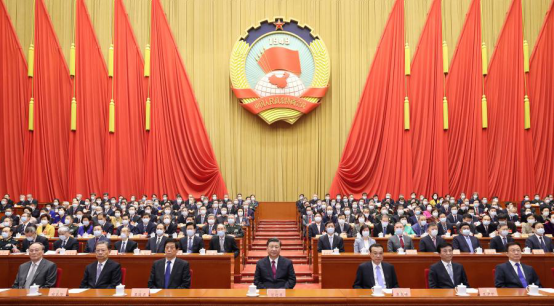
The closing meeting of the fourth session of the 13th National Committee of the Chinese People’s Political Consultative Conference (CPPCC) is held at the Great Hall of the People in Beijing, capital of China, March 10, 2021. Xi Jinping, Li Keqiang, Li Zhanshu, Wang Huning, Zhao Leji, Han Zheng and Wang Qishan attended the closing meeting. Wang Yang presided over the closing meeting and delivered a speech. (Xinhua/Huang Jingwen)


BEIJING, March 10 (Xinhua) — China’s top political advisory body concluded its annual session on Wednesday afternoon, calling for concerted and unremitting efforts toward realizing the Chinese Dream of national rejuvenation.


Xi Jinping and other Chinese leaders — Li Keqiang, Li Zhanshu, Wang Huning, Zhao Leji, Han Zheng and Wang Qishan — attended the closing meeting of the fourth session of the 13th National Committee of the Chinese People’s Political Consultative Conference (CPPCC) in Beijing.


Wang Yang, a member of the Standing Committee of the Political Bureau of the Communist Party of China (CPC) Central Committee and chairman of the National Committee of the CPPCC, presided over the meeting.


A resolution on a work report of the Standing Committee of the CPPCC National Committee, a resolution on a report on how the proposals from political advisors have been handled since the previous annual session, a report on the examination of new proposals, and a political resolution on the fourth session of 13th CPPCC National Committee were approved at the meeting.


The political advisors unanimously agreed to support the National People’s Congress — the national legislature — in making a decision on improving the electoral system of the Hong Kong Special Administrative Region.


Addressing the meeting, Wang Yang said the session had focused on the blueprint for the country’s social and economic development over the next five to 15 years.


This year marks the centenary of the CPC and the first year for the country to implement its new five-year development plan and begin its new journey toward fully building a modern socialist country, he said.


Wang called on the CPPCC to pool wisdom and strength of Chinese people at home and abroad to make contributions to securing a good start for fully building a modern socialist country.


The CPPCC must take upholding and strengthening Party leadership as the fundamental political principle and major political responsibility, he said, urging the CPPCC to better play its role as a platform for consultative democracy.


Wang also called for continuous efforts to advance the cause of the CPPCC and the development of the CPPCC as a specialist consultative body, so as to celebrate, with outstanding achievements, the centenary of the CPC.


Before the closing meeting, Wang presided over a meeting of the Standing Committee of the 13th CPPCC National Committee.

http://www.wuhu.gov.cn/English/News/29957851.html

5 Billion Yuan Kitchen Heat Intelligent Appliance Industrial Park Project of Midea Group Settled in Wuhu

On the morning of March 10th, Wuhu Economic and Technological Development Zone and Midea Group signed a kitchen heat intelligent appliance industrial park project with a total investment of 5 billion yuan. Shan Xiangqian, Deputy Secretary of the CPC Municipal Committee and Mayor of Wuhu, and Xu Minfeng, President of Midea Group’s Kitchen Heat Business Division witnessed the signing and had a discussion.


Shan expressed congratulations on the signing of the project. He pointed out that over the years, Midea has been deeply engaged in Wuhu, resonating with the urban development, and has become a faithful “witness”, a close “partner” and an important “contributor” to Wuhu’s development of substantial economy. At the beginning of the 14th Five-Year Plan, Wuhu is trying its best to promote the work of “double recruitment and double introduction”, introducing new measures and seeking new breakthroughs in the aspects of investment attraction of the whole industrial chain, helping enterprises reduce costs and attracting and cultivating all kinds of talents. The signing of the Midea Kitchen Heat Intelligent Appliance Industrial Park marks the cooperation between Wuhu and Midea has entered a new stage. It is hoped that both sides will work together to build the project into the first “Lighthouse Factory” in Wuhu, creating a new model and injecting new momentum into the intelligent manufacturing industry in Wuhu. Municipal Party Committee and Municipal Government of Wuhu will, as always, provide quality services, so as to promote mutual benefit and common development of both sides.


Xu Minfeng thanked Wuhu Municipal Party Committee and Municipal Government for their strong support to the enterprise all the time. He said that in recent years, the economic and social development of Wuhu has made encouraging achievements, and the high quality and efficient business service environment is heartwarming, which further strengthens the confidence and determination of Midea Group to develop in Wuhu. Midea Group attaches great importance to this project, and has sent dozens of experts to form a think tank to guide and evaluate the project on-site, to help build a world-class “Lighthouse Factory” for the project, and to make new and greater contributions to the high-quality development of Wuhu during the 14th Five-Year Plan.


Translated by Yuan Mengwen from Foreign Affairs Office of Wuhu Municipal People’s Government

http://www.wuhu.gov.cn/English/News/29957431.html