Skip to contentSkip to left sidebar Skip to footer

News

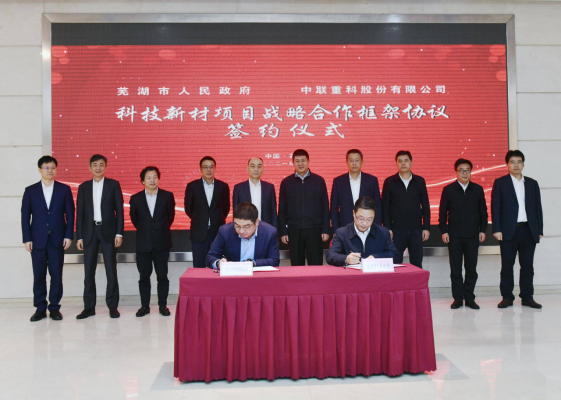
Wuhu Municipal Government Signed a Cooperation Agreement on Scientific and Technological New Materials Project with Zoomlion

Recently, Wuhu Municipal Government signed a strategic cooperation framework agreement for the new science and technology materials project with Zoomlion. Zhan Chunxin, Chairman and CEO of Zoomlion, Shan Xiangqian, Secretary of CPC Wuhu Municipal Community, and Ningbo, Deputy Secretary of CPC Wuhu Municipal Community and Mayor attended and witnessed the signing ceremony. Municipal leader Zhang Zhihong and secretary general of the municipal government Wang Zhipeng were present at the meeting.

    Zoomlion New Materials Project in Wuhu is located in Sanshan Economic Development Zone, with a planned land area of 30 hectares and an estimated total investment of 1.5 billion yuan. The project will build the world’s leading technical mortar production line, promote mechanized construction and upgrading of the construction industry, strength the use of gypsum, slag and other industrial by-products instead of cement and other high energy consumption raw materials and reduce the total energy consumption of products. It also plans to build production lines for new building waterproof materials and building heat preservation and energy-saving decorative materials to promote energy conservation and consumption reduction.

It is understood that the project takes high efficiency, energy saving and intelligent manufacturing as the concept for design and operation, and strives to build the world’s most advanced manufacturing enterprise in the area of new functional building materials so as to speed up the upgrading of new materials industry in Wuhu and contribute to the national strategy of ” carbon peak and neutrality”.

Translated by Yuan Mengwen from Foreign Affairs Office of Wuhu Municipal People’s Government

https://www.wuhu.gov.cn/English/News/32420281.html

Wuhu-Xuanzhou Airport to Open Multiple Flight Routes

It was recently learned from Wuhu-Xuanzhou Airport Investment and Construction Co., Ltd. that starting from the end of this month, Wuhu-Xuanzhou Airport will officially implement the winter and spring flights and open multiple routes.

According to the new flight plan, starting from October 31, Wuhu-Xuanzhou Airport will successively open five flight routes, including, Qingdao, Zhuhai, Harbin, Sanya, and Xishuangbanna, which will be operated by Donghai Airlines, Hainan Airlines and Lucky Air. Qingdao and Xishuangbanna routes are operated every Tuesday, Thursday and Saturday, while Zhuhai, Harbin and Sanya routes are operated on a daily basis.

Up to now, Wuhu-Xuanzhou Airport has opened 11 routes to Daxing District in Beijing, Guangzhou, Foshan, Shuangliu District in Chengdu, Chongqing, Xi’an, Kunming, Changchun, Shenzhen (2 routes) and Tianjin. Flight routes to Beijing, Tianjin, Hebei, cities in Pearl River Delta and major cities in western China are connected. According to the Airport, in the future, new flight routes will be opened in due course based on the big data analysis of travel and the needs of economic development to facilitate the travel of people in Wuhu and Xuancheng.

Translated by Wang Mengxiao from Foreign Affairs Office of Wuhu Municipal People’s Government

https://www.wuhu.gov.cn/English/News/32420251.html

Wuhu-Xuanzhou Airport to Add Multiple Flight Routes

It was recently learned from Wuhu-Xuanzhou Airport Investment and Construction Co., Ltd. that starting from the end of this month, Wuhu-Xuanzhou Airport will officially implement the winter and spring flights and add multiple routes.

According to the new flight plan, starting from October 31, Wuhu-Xuanzhou Airport will successively add five flight routes, including, Qingdao, Zhuhai, Harbin, Sanya, and Xishuangbanna, which will be operated by Donghai Airlines, Hainan Airlines and Lucky Air. Qingdao and Xishuangbanna routes are operated every Tuesday, Thursday and Saturday, while Zhuhai, Harbin and Sanya routes are operated on a daily basis.

Up to now, Wuhu-Xuanzhou Airport has opened 11 routes to Daxing District in Beijing, Guangzhou, Foshan, Shuangliu District in Chengdu, Chongqing, Xi’an, Kunming, Changchun, Shenzhen (2 routes) and Tianjin. Flight routes to Beijing, Tianjin, Hebei, cities in Pearl River Delta and major cities in western China are connected. According to the Airport, in the future, new flight routes will be opened in due course based on the big data analysis of travel and the needs of economic development to facilitate the travel of people in Wuhu and Xuancheng.

Translated by Wang Mengxiao from Foreign Affairs Office of Wuhu Municipal People’s Government

https://www.wuhu.gov.cn/English/News/32420251.html

The Second Seminar on the Protection and Development of Wuhu Iron Painting Held

On the morning of October 9, the “2021 (2nd) Seminar on the Protection and Development of Wuhu Iron Painting” was held in the hall of Tieshan Hotel in the city to summarize the achievements made in the protection and development of Wuhu iron painting in the past five years since the issue of the Regulations on the Protection and Development of Wuhu Iron Painting, analyze the existing problems and difficulties, and clarify the overall ideas for the protection, preservation, innovation and development of Wuhu iron painting in the next few years.

The seminar was hosted by the Wuhu Municipal Bureau of Culture and Tourism and Wuhu Cultural Centre (Municipal Intangible Cultural Heritage Protection Center) and organized by Wuhu Iron Painting Association. Nearly 100 representatives in the city, including well-known painters, experts and scholars in culture and history and intangible cultural heritage, heads of related companies in this industry, inheritors of forging skills, and iron painting craftsmen attended the seminar. The representatives discussed how to further implement the Regulations on the Protection and Development of Wuhu Iron Painting and how to make it well-known in the Yangtze River Delta, the country, and the whole world. In the seminar, the atmosphere was very active. The experts called for strengthening the protection of Wuhu iron painting forging skills, carrying out researches on the art, culture and history of the painting, so that the traditional forging skills can be passed on in a living status.

It is learned that in the five years since the issue of the Regulations on the Protection and Development of Wuhu Iron Painting, Wuhu Municipal Finance Bureau has set up a “Special Fund for the Protection and Development of Wuhu Iron Painting” with an annual amount of 500,000 yuan.


Translated by Wang Mengxiao from Foreign Affairs Office of Wuhu Municipal People’s Government

https://www.wuhu.gov.cn/English/News/32420181.html

National Reunification Must and Will Definitely Be Fulfilled

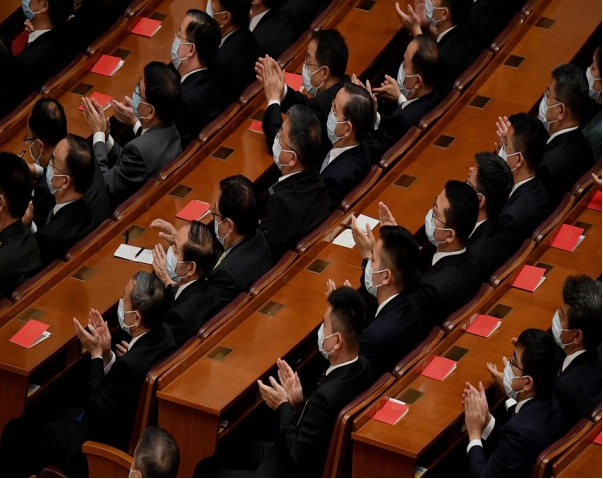
Delegates applaud during the commemoration of the 110th anniversary of the Xinhai Revolution which overthrew the Qing Dynasty and led to the founding of the Republic of China, at the Great Hall of the People in Beijing, October 9, 2021.

This year marks not only the centenary of the Communist Party of China, but also the 110th anniversary of the Chinese Revolution of 1911, better known as the Xinhai Revolution. In a grand ceremony at the Great Hall of the People on October 9, Chinese President Xi Jinping delivered remarks to commemorate this historic event and appealed to the goal of national reunification.

Xinhai Revolution as a milestone

President Xi paid tribute to the glorious achievement by the revolutionary pioneers and ascribed the Xinhai Revolution as “a towering milestone of the great rejuvenation of the Chinese nation.”

The Xinhai Revolution was the first democratic revolution in Chinese history, with profound implications on the Chinese nation. It overthrew the Qing Dynasty and ended absolute monarchy that ruled China for thousands of years, and paved the way for the modern China by establishing the Republic of China, the first republic in Asia.

More importantly, it ushered in an Enlightenment movement across China where the national consciousness was awakened and the ideal of democracy and republicanism took hold in Chinese people’s minds. Epitomized in the “three people’s principles” put forward by pioneer of China’s democratic revolution Sun Yat-sen, which include the principles of nation, democracy and the people’s livelihood, the ideals of the Xinhai Revolution inspire the Chinese people to this day.

Xi acknowledged the significance of the Xinhai Revolution, and remained clear-eyed to its shortcomings. As later history showed, great as it was, the Xinhai Revolution failed to end the Chinese semi-colonial and semi-feudal status and did not lift the Chinese people out of poverty and misery.

Drawing on the lessons of the Xinhai Revolution, President Xi made it clear that the strong leadership of the Chinese Communist Party and the path of Socialism with Chinese Characteristics together with the collective struggle of the Chinese people are the pillars of China. He also appealed to strengthen the consciousness of “a community for the Chinese nation” and unite the best and brightest Chinese for the great rejuvenation of the Chinese nation.

His remarks were borne out by history. It was the advent of the Communist Party of China and the founding of the People’s Republic of China in 1949 that effectively ended the 100 years of humiliation. China has shed the old shackles, and re-emerged as an independent, prosperous and proud nation.

National reunification as the common aspiration of the Chinese nation

President Xi’s remarks on national reunification were widely anticipated as the tensions across the Taiwan Straits have heightened recently. By quoting Sun Yat-sen’s statement that “unification is the common aspiration of the Chinese nation. Unified, the Chinese people will prosper; otherwise, we will suffer as a result,” Xi pledged to fulfill the unfinished cause of national reunification and realize the great rejuvenation of the Chinese nation.

Xi expressed confidence as he addressed the root cause of the Taiwan issue, “the Taiwan issue was a result of national weakness, and will definitely be resolved following national rejuvenation.” He declared, “achieving the national reunification by peaceful means is in the common interest of the Chinese nation, including the compatriots of Taiwan.” For this purpose, he pledged to adhere to the basic principles of peaceful reunification and one-country two-systems, as well as the one-China policy and the “1992 consensus.”

The Chinese president issued stern warnings to the secessionist forces, “those who forget their ancestry, betray their motherland and divide the country never end well, and will be spurned by the people and judged by history.”

He also reiterated that the Taiwan issue is China’s internal affair and outside intervention would never be allowed. He is obviously making a veiled rebuke to the U.S. and other countries which are attempting to instigate Taiwan secession. In a latest revelation, the U.S. has secretly deployed its troops in Taiwan for at least a year.

But recent events also showed signs of easing. U.S. President Joe Biden and National Security Advisor Jake Sullivan both reiterated the U.S. commitment to the one-China policy. It demonstrates that the U.S. knows well the sensitivity of the Taiwan issue and finds it imperative to responsibly manage relations with China and refrain from provoking the Chinese people.

After all, national sovereignty and territorial integrity is of high importance to any country in the world. With firm determination and strong will, Chinese people would ensure that the “historical task of complete national reunification must be fulfilled and will definitely be fulfilled.”

https://www.wuhu.gov.cn/English/News/32420081.html

At Least 9 Provinces in China Launch Booster Shots for Key Groups

At least nine provinces in China launch booster shots for key groups, ‘helpful supplement measure’ for Beijing Winter Olympics.

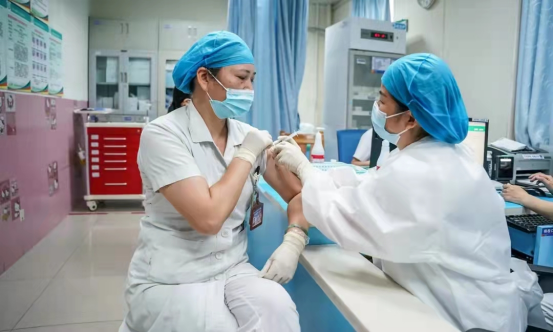
A medical staff member receives a booster shot of a COVID-19 vaccine on Saturday in Nanning, South China’s Guangxi Zhuang Autonomous Region. Photo: VCG


As the winter comes and the Beijing 2022 Winter Olympics approaches, China is accelerating the inoculation of booster shots for key groups, with at least nine provinces and regions having started the campaign to further consolidate the nation’s epidemic prevention and control achievements, and to improve the protection efficacy for people at high risk of infection in a timely manner.

In the latest move, cities in four provinces including East China’s Anhui, Fujian, Northeast China’s Heilongjiang, and Central China’s Hubei and in South China’s Guangxi Zhuang Autonomous Region launched the campaign during the weekend.

Nanling county in Wuhu, Anhui launched booster shots for people who completed the vaccination six months ago on Friday. Prior to that, several districts in the city had already started booster shots.

A community in the city’s Jiujiang district released a notice on Thursday, advising people aged between 18 and 59 who finished two doses of inactivated vaccines six months ago to get a booster shot with the same vaccine.

Other cities in Anhui including the capital city Hefei and Fuyang also started the booster shots on Saturday.

In East China’s Fujian Province, two cities – Jinjiang and Xiamen – started booster shots on Saturday and Sunday in succession. The whole province had just returned to low-risk status on Thursday after a flare-up that began on September 10. The outbreak spread to Putian, Quanzhou, Xiamen and Zhangzhou, where many infected people had completed their vaccination series when they contracted the Delta variant during the resurgence.

In Jinjiang, a booster shot for people at high risk is set to be accomplished by October 20. In Xiamen, a booster shot will target people aged 12 and above who have finished two doses of inactivated vaccines or the one-shot recombinant adenovirus vector vaccine six months ago. They will take a booster shot with the same technical route as the vaccines they took.

So far, the Global Times has learned that dozens of cities in at least nine provinces and regions have given or soon will give booster shots to key groups.

China had administered 2.22 billion doses of COVID-19 vaccines as of Saturday, according to the National Health Commission.

A Beijing-based immunologist told the Global Times on condition of anonymity on Sunday that the intensive policies rolled by these cities across the nation recently may be related to the upcoming Beijing 2022 Winter Olympics.

Although the Games will absolutely have very strict prevention and control measures, a booster shot for the key groups can be a very helpful supplement, said the expert.

Tao Lina, a Shanghai-based vaccine industry insider, told the Global Times on Sunday that scientific research showed that antibodies in recipients turned negative after six months and booster shots can better protect key groups.

Protection efficacy was raised to 80 percent or above after inoculation with a third dose of SinoVac COVID-19 vaccine as a booster, with protection efficacy for infections with symptoms raised from 56 percent to 80.2 percent and from 84 percent to 88 percent for those who needed to be hospitalized, the company announced on Saturday, citing the latest research result in Chile.

Zheng Zhongwei, director of the Development Center for Medical Science and Technology of the National Health Commission, and head of the national working group for vaccine development, told a press conference on August 27 that three groups of people can receive booster shots six months after the completion of two doses. These groups at high risk of infections include those who work at customs and border inspection offices, those in the aviation industry, employees of quarantine centers and staffers at designated medical institutions.

https://www.wuhu.gov.cn/English/News/32420071.html

Pics Boost Patriotic Sentiment in Hong Kong

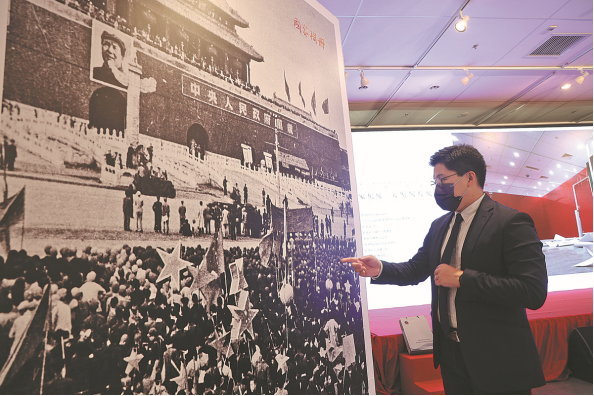
Kenneth Fok Kai-kong, a member of the 13th National Committee of the Chinese People’s Political Consultative Conference, admires a photo during an exhibition at the Hong Kong Central Library on Friday. The event features photos showing China’s development over the past century. [Photo by Edmond Tang/China Daily]


Central government officials on Friday called on Hong Kong society to improve the education standards of modern Chinese history and foster stronger national identity to ensure the city moves forward on the right track.


They made the remarks at the opening ceremony of an exhibition in the Hong Kong Special Administrative Region featuring photo collections of China’s development over the past century. The exhibition also highlights Hong Kong’s growing ties with the motherland.


A total of 226 photos were selected from 10 million from the Xinhua News Agency with themes covering China’s drastic changes in economy, education, environment, culture and social life. The exhibition is open to the public from Saturday to Oct 17 at the Hong Kong Central Library before the photos will be toured about the broader community, including on university campuses.


An entire chapter of 78 photos is about Hong Kong, from the workers’ strike against foreign capitalist exploitation in 1922 to this year’s grand celebrations of the SAR’s 24th anniversary of the return to the motherland in July.


In a video address, Deng Zhonghua, deputy director of the Hong Kong and Macao Affairs Office of the State Council, said he hoped the exhibition will be an opportunity for local authorities to beef up education on Chinese history.


Deng emphasized the promotion of China’s modern and contemporary history that included the leadership of the Communist Party of China, reform and opening-up, and the practice of “one country, two systems”.


Hong Kong people will cultivate deep feelings toward their motherland and “draw strength” from history. The correct view of history will lead to a consensus in the community and guide society on the right path of implementing “one country, two systems”, he added.


Lu Xinning, deputy director of the Liaison Office of the Central People’s Government in the Hong Kong SAR, said the young generation in Hong Kong is in urgent need of Chinese history education, which will help them distinguish between right and wrong and avoid “going astray”.


When Hong Kong people develop a solid sense of national identity, the city will be better protected from destructive forces, Lu said.


Hong Kong Chief Executive Carrie Lam Cheng Yuet-ngor agreed with the need for such public education, saying that the exhibition will help Hong Kong people to have a deeper understanding of modern China and promote patriotic education, as a series of local events did in recent months to celebrate the 100th anniversary of the founding of the CPC and National Day.


The exhibition is jointly organized by the HKSAR government, the liaison office and Xinhua. An album of the exhibited photos was released in Hong Kong on Friday.


Kenneth Fok Kai-kong, a member of the 13th National Committee of the Chinese People’s Political Consultative Conference who attended the opening ceremony, said he would recommend young people visit the exhibition. By understanding the history and the progress of the nation, the youngsters can think more about how to contribute to the future development of the country, Fok said.


Principals, such as Kelvin Yau Siuhung of Yan Chai Hospital Wong Wha San Secondary School, and Hui Chung-lung of HKFEW Wong Cho Bau Secondary School, told China Daily that they would soon arrange group visits for their students.


Yau said he was impressed by the graphic story of many soldiers sacrificing themselves in building a highway in western China in the 1950s. He hoped students would understand the country’s intention and determination to serve the people.


Hui expects students will have more confidence in the bright prospects of Hong Kong’s development in tandem with those of the country, with the knowledge that Hong Kong has always been closely linked to the motherland.

https://www.wuhu.gov.cn/English/News/32420011.html

Carbon Neutrality Can Lead to New Economic Miracle

President Xi Jinping has pledged that China will make every effort to peak its carbon emissions before 2030 and achieve carbon neutrality before 2060.

But why is China giving such importance to these two climate goals?

China has done so because it will help it to decide the country’s future course of development.

In the past 40-odd years, China’s economy has grown at an average annual rate of 9.4 percent, thanks to the improvement in production efficiency brought about by technological progress and institutional innovation. The abundance of labor and the role workers have played in China’s industrialization have been vital factors promoting its economic growth.

China has made important institutional innovations. Through robust investments in land and real estate, a large amount of fixed assets have been created, a part of which has been used as collateral to get bank loans, which together have expanded social credit.

To a large extent, China’s persistent efforts to advance industrialization have played a crucial role in the country’s rapid economic development. But at a time when China has entered the higher stage of industrialization and when the growth rate of its total factor productivity has slowed down, it is difficult for it to maintain high economic growth. This largely explains why realizing carbon neutrality has become so important for China.

Reindustrialization, greater efficiency in resource allocation through deeper reforms and wider opening-up, and realizing carbon neutrality are some of the factors that could produce the second “miracle” for China’s and the world’s economic and social development.

Reindustrialization means digital transformation of industries. The use of big data and artificial intelligence to drive industrial transformation can significantly improve total factor productivity. As one of the elements needed for “reindustrialization”, new infrastructure construction will revolve around industrial reform and infrastructure construction for industrial internet, such as 5G base stations and cloud computing equipment.

The construction of 5G base stations in the next five years is expected to cost 1.3 trillion yuan ($201 billion), or 260 billion yuan per year, but it will create lots of investment opportunities.

China has built the most complete industrial chain in the world, but it has not been able to form a “closed loop” for some key components and technologies. So the future development of industries such as civil aviation, aircraft and spacecraft engines, and integrated circuits will possibly improve total factor productivity. Maintaining a certain proportion of manufacturing is conducive to total factor productivity improvement, and deeper reform and wider opening-up will boost the efficiency of resource allocation.

Improving total factor productivity mainly depends on scientific and technological progress and a better incentive mechanism. Deepening overall reform, including institutional reform, and further opening-up can also create a huge institutional dividend space, which along with science and technology development could lead to higher total factor productivity.

This is the most important way to boost China’s total factor productivity growth. If China improves its efficiency in investment and resource allocation following the principle of competitive carbon neutrality, it could create a new economic miracle.

The huge investment opportunities created throughout the process of realizing carbon neutrality will not only help boost China’s economy in the short term but also influence its overall socioeconomic development in the long run. In its 2021 annual report, the International Renewable Energy Agency has stressed that in order to comply with the 2015 Paris Agreement, the world needs to achieve net zero carbon dioxide emissions by around 2050.

According to the agency’s estimates, the total global investment needed to achieve all Paris Agreement goals is as high as $131 trillion. China’s current carbon emission is about 10 billion tons. If the agency’s calculation is correct, to realize carbon neutrality, China will need an investment of 255 trillion yuanand the impact of such a huge investment on the country’s economy and society will be much greater than imagined.

So what will be the mode and path of China’s economic transformation on way to realizing carbon neutrality?

All industries have formed their upstream-downstream relations and constitute the links in the industrial chains. We can find in these links some “nodal industries”, those that hold key positions in the national economy and are related to other industries. Identifying such nodal industries and accordingly formulating industrial policies and making corresponding technological changes will help produce multiplier effects in the economy.

The need for China is to establish an effective carbon pricing mechanism and promote differential carbon pricing in different regions to produce a positive impact on production and other economic activities.

But to realize carbon neutrality China has to rely on a large number of micro-market subjects, and entrepreneurs have to build stronger industrial chains to promote the further development of the national economy. As for the authorities, they have to ensure that the micro, small and medium-sized enterprises maintain their smooth operation and boost their production.

https://www.wuhu.gov.cn/English/News/32419961.html

Passenger Flow Volume of Wuhu-Xuanzhou Airport during the National Day Holiday Hit a Record High

According to the Wuhu-Xuanzhou Airport Investment and Construction Co., LTD, during the National Day holiday, a total of 132 inbound and outbound flights were guaranteed, with a passenger throughput of about 9,500, a new high since its operation.

According to the introduction, since the National Day holiday, Wuhu-Xuanzhou Airport actively do a good job of flight security work, in order to deal with the possible situation with large passenger flow. According to statistics, during this holiday, Wuhu-Xuanzhou Airport sent more than 1300 passengers per day. On October 1st, 1627 passengers arrived and left the port, hitting a record high since the day of opening.

At present, Wuhu-Xuanzhou Airport has opened 11 routes to Beijing Daxing, Guangzhou, Foshan, Chengdu Shuangliu, Chongqing, Xi ‘an, Kunming, Changchun, Shenzhen (2 lines) and Tianjin. At the end of this month, the airline to Zhuhai Jinwan Airport will officially be opened , and in the future, new routes will be opened successively to meet the travel needs of the vast number of citizens in the two cities.

Translated by Yuan Mengwen from Foreign Affairs Office of Wuhu Municipal People’s Government

https://www.wuhu.gov.cn/English/News/32420351.html

Wuhu Rail Transit Line 1 Starts Trial Ride

On September 25, Wuhu Rail Transit Line 1 launched a one-month free trial ride. 10,000 citizen representatives every week and 40,000 people in total will take the lead in experiencing the country’s first unmanned straddling monorail train.

Wuhu Rail transit Line 1, with a total length of about 30 km, runs along the city from south to north and has 24 elevated stations.During the trial period, 7 stations and 6 sections from Jiuzi SquareStation to Tianzhushan Road Station are temporarily open for citizens to experience.Citizens can check in and out at Jiuzi Square Station and Tianzhushan Road Station. Jiuzi Square Station is the only transfer station for Line 1 and Line 2, and it is also the highest and largest frame station on the whole line. The first floor is equipped with station access, stairs and elevators; The second floor is the entrance hall, equipped with automatic ticket machines, electronic road map, security check instrument, gate and other equipment; The third floor is the platform.

Straddling monorail transit system has the characteristics of safety and reliability, low noise, high ride comfort, good lighting effect and so on. It is regarded as a “little train in the sky”. It is not only the carrier of urban public transportation, but also a good place for sightseeing. The design speed of the rail transit is 80 km/h. Thewhole journey of Line 1 takes about 1 hour while that of Line 2 is 30 minutes. This means a half-hour traffic circle centered on Jiuzi Square was formed, with an hourly traffic volume of about 10,000 to 30,000 people, which can quickly solve the rush hour congestion in the downtown area and facilitate life of citizens.

Trial ride is a common practice in cities that have opened rail transit in China. The month of trial ride is organized to better collect suggestions and feedback from citizens during their experience improve the quality of operation service, and help the initial operation of line 1 to be safer, more comfortable and more convenient.

In this month of trial ride, free experiencing coupons will be issued. The first week, from September 25th to October 1st, the coupons will be distributed to Wuhu good people, model workers, volunteers, representatives of communities, media, enterprises and institutions, etc. From the second week to the fourth week, coupons will be distributed to the public through media and other channels. Citizens who want to experience the trial ride can continue to follow the latest news of Wuhu Rail Transit to receive the trial ride experience tickets.

Wuhu Yunda Rail Transit Construction and Operation Co., Ltd. reserves the right to interpret the trial ride. The subsequent arrangements will be timely adjusted according to the actual situation of the trial ride and will be released through the media as soon as possible.


Translated by Yuan Mengwen from Foreign Affairs Office of Wuhu Municipal People’s Government

https://www.wuhu.gov.cn/English/News/32039901.html