
Skip to contentSkip to left sidebar Skip to footer

Uncategorized

9 Must-Visit Classic Attractions in Wuhu

9 Must-Visit Classic Attractions in Wuhu

Wuhu, historically known as Jiuzi and nicknamed “River City,” is a prefecture-level city in Anhui Province. Located in the middle and lower reaches of the Yangtze River, with the southern Anhui mountain range to its south and the Jianghuai Plain to its north, it serves as a central city in the Yangtze River Delta region. Known as the “Famous City of Jiangdong,” Wuhu has earned the reputation of “Half City Mountains, Half City Waters” due to its beautiful landscapes, crisscrossing rivers, and scattered lakes.

Here are nine classic attractions you shouldn’t miss when visiting Wuhu:

1. Fantawild Tourism Resort ⭐⭐⭐⭐⭐

Wuhu’s most famous 5A-rated theme park destination. The resort features four distinct theme parks: Fantawild Adventure, Fantawild Dreamland, Fantawild Water Park, and Fantawild Oriental Heritage. Each park offers unique experiences from thrilling rides to cultural performances, making it a comprehensive leisure destination.

2. Tianmen Mountain

Also known as Dongliang Mountain, Tianmen Mountain consists of two peaks facing each other across the river. Standing majestically in the Yangtze River like a knife-cut cliff, it’s famous for its unique mountain shape and the “Tianmen Mist and Waves” scenery. The mountain features Tianmen Academy (one of Anhui’s earliest academies dating to the Southern Song Dynasty), Tongfo Temple, and glass skywalks.

3. Maren Peak

Known as “Zhangjiajie of Southern Anhui” and “Little Huangshan by the River,” Maren Peak features bizarre peaks, steep cliffs, stone pillars, caves, and ancient trees. The scenic area includes Maren Temple, Longevity Cave, Hundred Waterfalls, nanmu forests, geological museum, and the spectacular Dragon Flying Glass Bridge spanning between peaks.

4. Zheshan Park

Named after its distinctive reddish-brown (zhe-colored) rocks, this park was formerly known as Wuhu Park. Composed of two hills with dense forests and numerous historical sites, it integrates leisure, hiking, and exploration. The park contains Guangji Temple, the tomb of famous educator Liu Xiping, and the tomb of General Dai Anlan, a hero of the Anti-Japanese War.

5. Jiuzi Ancient Town

Located along the Bianfu River, this is actually Anhui’s largest ancient town. Founded in the Southern Song Dynasty and flourished during the Ming and Qing dynasties, it features numerous Hui-style buildings and merchant culture. The town is divided into east and west sections by the river, with the east offering dining and accommodation, while the west preserves guild halls, academies, and celebrity residences.

6. Jinghu Park

Wuhu’s central urban park, located near Zheshan Mountain and the Qingyi River. The lake is clear and mirror-like, giving the park its name (Mirror Lake). Composed of Big and Little Mirror Lakes, the park features pavilions, bridges, and historic sites including the statue of Xiao Yunchen, the Aying Library, and the Wang Buwen Memorial Pavilion. It’s considered one of the “Eight Scenic Views of Wuhu.”

7. Binjiang Park (Riverside Park)

Stretching along the Yangtze River from Wuhu Shipyard to Lugang Bridge, this park combines old docks with river views. Known as the “Bund of Wuhu,” it features historic buildings including the Old Customs House, churches, Taikoo Dock, and Zhongjiang Pagoda (built in the Ming Dynasty, known as “Hibiscus on the River”). The park showcases both historical heritage and modern architecture.

8. Zhongshan Pedestrian Street

Established in 1902, this is one of China’s three great pedestrian streets alongside Beijing’s Wangfujing and Shanghai’s Nanjing Road. As the former leading rice market and early treaty port, Wuhu created one of China’s earliest commercial streets. The 700-meter street features shopping, dining, and entertainment, representing the city’s commercial prosperity.

9. Xihe Ancient Town

Located on the west bank of the Yi River, this town dates to the Hongwu era of the Ming Dynasty. It flourished as a commercial hub for merchants traveling to Wuhu from southern Anhui. The town preserves traditional workshops, old shops, and historic sites including Wannian Stage and Wenchang Pavilion. The riverside dwellings built on stilts are known as “Jiangnan Stilt Houses.”

Whether you’re interested in natural scenery, historical culture, or modern entertainment, Wuhu offers diverse attractions that showcase the charm of this riverside city.

Wuhu Police Raid Nets 20 Suspects in Illegal Gambling Bust

Wuhu Police Raid Nets 20 Suspects in Illegal Gambling Bust

Wuhu, Anhui Province — April 3, 2026 — The Wuhu Municipal Public Security Bureau’s Fanchang Branch Patrol Brigade successfully dismantled an illegal gambling den following intensive investigation, apprehending 20 suspects at the scene.

On April 3, the patrol brigade received intelligence reports indicating that a residential property within their jurisdiction was being used as a venue for illegal gambling activities. The gambling operation utilized a traditional dice-based betting game known locally as “Yao Dan Shuang” (odd-even betting).

Coordinated Strike Operation

Upon receiving the tip, authorities immediately activated their specialized response protocol. Officers conducted thorough reconnaissance and surveillance operations, gradually mapping out the exact location and internal layout of the gambling den.

When the moment was right, a lightning-fast raid was executed. Police officers stormed the residential property with swift precision, immediately securing control of all individuals present inside.

Operation Results

  • 20 gambling suspects apprehended on site
  • Over 80,000 yuan in gambling funds seized
  • Dice and other gambling paraphernalia confiscated as evidence

All suspects and seized materials have been processed according to law, and the case remains under active investigation.

Official Warning

Wuhu police issued a stern warning to the public: “Gambling promises nine losses out of ten. Do not harbor illusions of easy winnings. Regardless of the method or form, participation in gambling constitutes illegal criminal activity, and public security organs will crack down severely in accordance with the law.”

Authorities encourage citizens to report any suspected gambling activities or related criminal behavior to police immediately.

Source: Wuhu Police Department

Wuhu Police Raid Nets 20 Suspects

Huawei Cloud Ecosystem Conference 2025 Opens in Wuhu

Wuhu, Anhui Province — April 10, 2025 — The Huawei Cloud Ecosystem Conference 2025 kicked off in Wuhu City, bringing together industry leaders, experts, and scholars to explore new pathways for integrating intelligent technology with industrial development.

Themed “Collaborative Innovation: Accelerating Industry Intelligence Transformation,” the two-day event featured keynote addresses from Xu Zhi, Deputy Secretary of the Wuhu Municipal Committee and Mayor, and Zhang Ping’an, Huawei Executive Director and CEO of Huawei Cloud.

Wuhu Commits to Building a National Computing Power Hub

In his opening remarks, Mayor Xu highlighted Wuhu’s strategic focus on seizing opportunities presented by China’s “East Data, West Computing” national strategy. The city is positioning itself as a premier intelligent computing hub, with major projects accelerating and substantial achievements in digital-industrial integration, computing infrastructure, and industrial transformation through partnership with Huawei.

“Wuhu will continue to serve the prosperity of the ecosystem with the sincerity of an entire city,” Xu stated, outlining several key initiatives:

  • Jiuze Science and Innovation Bay: A flagship project with over 100 billion yuan in fund clusters to foster a robust technology innovation ecosystem
  • Yangtze River Delta Computing Hub Platform: Enabling cross-regional computing resource interconnection with 1,000+ computing and algorithm products
  • Data Infrastructure: Establishing foundational data systems to facilitate data circulation and trading
  • AI+ Applications: Promoting artificial intelligence integration across various scenarios
  • Digital Transformation: Assisting manufacturing enterprises in cloud adoption and digital upgrades

Industry Leaders Share Insights

The conference featured keynote presentations from industry executives including Pan Qinghua, Vice President of iFlytek and Dean of AI Engineering Institute, and Dai Chuang, Deputy General Manager of Chery Automobile. They shared insights on large AI model implementation and digital intelligence enabling industrial upgrading.

Additional events during the conference included ecosystem partner meetings, automotive intelligent driving industry sessions, and Huawei Cloud’s “President’s Night.”

The Huawei Cloud Ecosystem Conference 2025 concluded successfully on April 11, reinforcing Wuhu’s position as an emerging center for intelligent computing and digital innovation in the Yangtze River Delta region.

Notice: ID Card Services Suspended in Wuhu

Wuhu News

Notice on Suspension of Resident ID Card Services Due to System Upgrade

Due to the province-wide resident ID card system upgrade, the city will temporarily suspend certain ID card services in phases to maximize convenience for residents.

Relevant matters are hereby notified as follows:

– Starting from now until April 12: Suspension of first-time ID card applications through "cross-province" service
– April 11-12, 2026: Suspension of provincial ID card applications

Please plan accordingly and schedule your visits based on your needs. We apologize for any inconvenience caused.

Wuhu Municipal Public Security Bureau

April 8, 2026

Source: Ping An Wuhu

Wuhu Implements Spring and Fall Break for Primary and Secondary Schools in 2026

Wuhu News

Wuhu City has announced the implementation of spring and fall break system for compulsory education schools starting from the 2026 spring semester.

Under the new policy, both spring and fall breaks will be set at 3 days each, with time allocated from the flexible weeks of each semester. This ensures that the total teaching weeks and tasks required by national regulations are not reduced, while maintaining the existing winter and summer vacation schedules.

Specific arrangements: Spring break is for students in grades 1-8, combined with the Qingming holiday; Fall break is for students in grades 1-9, combined with November weekends to facilitate family travel planning. In 2026, Wuhu's spring break will be from April 1-3, forming a "3+3" 6-day holiday with the Qingming festival. Fall break arrangements will be announced before the fall semester begins.

The implementation of the spring and fall break system is an important livelihood initiative responding to societal needs in the new era. The policy aims to optimize teaching rhythms, reduce student academic pressure, encourage students to participate in research trips, physical exercise, cultural experiences, and other activities to improve comprehensive quality and core competencies.

Various departments in Wuhu will collaborate to ensure supporting measures for the break system. For families with childcare needs, relevant departments and schools will provide public childcare services and diverse holiday activities. The tourism sector will optimize services and encourage attractions to launch themed activities. Transportation and public security departments will enhance capacity and ensure travel safety.

Source: Wuhu Municipal Government

The Economist: China’s mid-sized cities are enjoying a property boom

FOR years Wuhu, a city (pictured) in the poor central province of Anhui, was on the front line of a national effort to reduce a glut of unsold homes. New property developments stretched into the haze along the Yangzi river on the town’s western edge. But buyers were scarce: although Anhui has a population about the size of Italy’s, many of its people have long preferred to work in richer parts of the country. Officials in Wuhu tried to entice locals to buy homes, offering tax breaks. At one point they even promised to subsidise the cost, an act of desperation that made Wuhu an emblem of China’s real-estate woes.

Since early 2016, however, the city’s property prices have soared by more than 30%. Earlier this month the city sharply changed tack, introducing measures to curb speculation. For example, it required that buyers of new homes wait at least two years before selling. Developers were ordered to set prices within predetermined ranges. The city also vowed to expand the land available for development. The glut of unsold homes is, in other words, no more. A shortage is the new concern.

The striking improvement in Wuhu’s property market has echoes around the country. It is one of the 60 or so cities deemed to be “third tier”. The designation refers not just to their political ranking and size (medium by China’s standards, with populations of roughly 1m-3m); until recently it also summed up prevailing sentiment about their prospects. Analysts and investors have generally been positive about China’s first-tier megacities (Beijing, Shanghai, Shenzhen and Guangzhou) and its second-tier giants, especially those in good locations such as Hangzhou in the east and Foshan in the south. But there was less enthusiasm for cities ranked in the third tier and below. They were seen as suffering from weak industrial bases, flimsy social services and a steady brain-drain as their most educated residents left for more exciting places.

Yet a rally in China’s property market, which began in its big cities in 2015, is filtering down to these also-rans. Housing prices in third-tier cities are up by 7% over the past year on average, and by much more in the best performers (see chart). Their markets have remained hot this year, even while their bigger peers have cooled off. This has helped to reduce the stock of unsold homes. The amount of housing for sale has fallen almost continuously for the past 14 months, the longest sustained decline since records began in 2001.
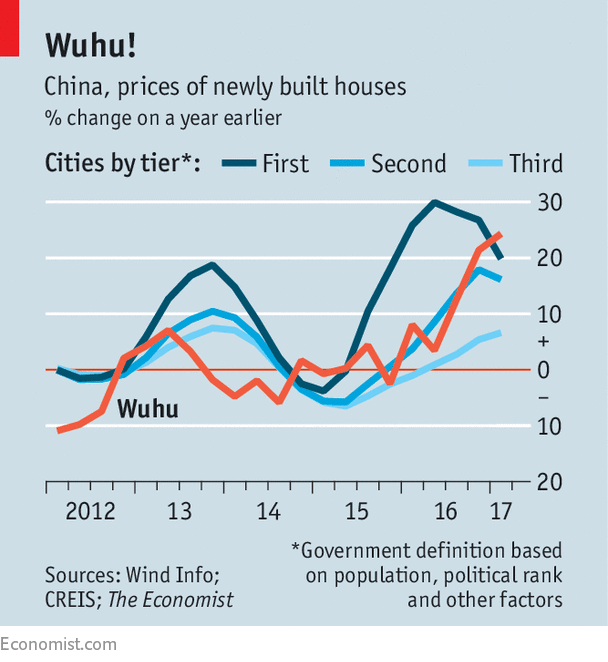

That would seem to be unambiguously good news. But a closer look at third-tier cities suggests caution is in order. Speculation has played a large role in their new-found prominence. Capital controls, progressively tightened over the past two years, have trapped cash in the country. After a stockmarket collapse in 2015, housing became the most appealing asset—all the more so when, to boost the economy, the government began encouraging state-run banks to increase their mortgage lending to homebuyers. After a run-up in prices in big cities, investors looked to smaller markets for bargains.

Recent government efforts to douse the fervour in big cities had a similar effect. When Hefei, Anhui’s capital, started restricting purchases last year, buyers rushed elsewhere, including to Wuhu. Li Guochang, head of a property-research institute in Anhui, estimates that people from outside Wuhu account for more than a quarter of purchases this year, up from the normal level of about a tenth. There are now roughly 20% more homes owned in Wuhu than there are households in the city, he says. As he puts it: “This doesn’t seem very healthy.”

Nevertheless, it is too easy to treat the rally in third-tier cities as froth. Owner-occupiers make up a majority of the market. Many are locals who have the means to move to nicer homes, tired of the shabby six-floor walk-ups that still dominate many old city-centres. As for speculators, they might just know a thing or two. It has been striking that the price surge in third-tier cities has not been evenly spread around China, but rather concentrated in markets that have better locations. Places that fall within the gravitational pull of the most prosperous cities, particularly in the east and south, have fared the best. But thanks to better infrastructure links, there are many more locations that can be defined as good. Wuhu used to be a backwater. Today it is less than three hours from Shanghai by high-speed rail. In the north and west of China, well away from its glittering coast, housing prices are about the same as they were five years ago.

Homeward bound

A cascade of development has also changed the economies of mid-sized cities. As land prices and wages have risen along the coast, companies have moved inland. Wuhu, for example, now boasts numerous robotics firms. Population flows are changing, too. Anhui is one of the main sources of the migrants who staff factories and work on construction sites around the country. But its permanent population has risen by 1.7m since 2014, buoyed by the return of some of its migrant workers.

Similar reversals are also occurring in two other big out-migration provinces: Sichuan in the south-west and Hunan, Anhui’s neighbour. Some migrants are returning because of old age—the government restricts their access to health care and other benefits in places other than where they were born (to control prices, some cities have recently limited their ability to buy homes, too). Others are lured by an improvement in job opportunities. A teacher at a vocational college in Wuhu says most of his students now stay put.

The central government wants to promote this trend: it believes it will help it achieve its goal of curbing the growth of the biggest cities. Shanghai’s population has nearly doubled since 1990, to 24m. Between now and 2040, the city is aiming for a maximum of 1m more residents. Smaller cities, meanwhile, are being encouraged to attract outsiders. Some, such as Wuhu, offer special grants to university graduates who choose to live in them.

China’s campaign to control city sizes may end up causing economic harm, placing artificial limits on the most productive urban centres. It is also deeply unfair to migrants from the countryside who have toiled for years in big cities but who have little hope of settling down permanently in them . But Wuhu and its third-tier brethren are not complaining: the restrictions, loathed by so many, are helping to give them life.